If you’re reading this, I’m guessing you’re not trying to figure out how to make more money.
You probably already have a good career. You’re contributing to retirement, paying your bills, and doing all the things you’re supposed to do financially. What you’re really trying to figure out is how to turn the money you’re already making into enough financial runway that you can actually step away from work and travel for an extended period of time.
That’s exactly where we found ourselves.
Looking back, saving $100,000 was never about cutting out coffee or becoming extreme with our budget. We still spent money on things that mattered to us. Our girls stayed in activities they loved, we prioritized healthy food, and we never stopped choosing experiences over things.
The biggest shift wasn’t how we spent our money. It was deciding what our money was actually supposed to do.
For years, we were doing what most high-income families do. We were paying down debt, investing for retirement, buying a home, and slowly building our life. Every decision made sense on its own, but none of those decisions were connected to a bigger goal. Our money was moving in a lot of different directions, and because of that, it never felt like we were getting any closer to having the freedom we wanted.
Once we decided we wanted to spend a year traveling with our kids, every financial decision suddenly had context. Instead of asking, “Can we afford this?” we started asking, “Is this helping us build the life we actually want?”
That one question changed almost everything.
This article isn’t about convincing you that you need to save $100,000 before you leave. I don’t believe that’s true. What I do hope is that by sharing the framework we used, the mistakes we made, and the decisions that mattered most, you’ll walk away with a clearer idea of how to build a travel runway that fits your family’s goals instead of trying to copy ours.

Our Starting Point Wasn’t What Most People Think
Whenever people hear that we saved $100,000 before taking a family gap year, I think they picture one of two scenarios. Either we came from money, or we were making so much that saving six figures was easy.
Neither was true.
My husband and I are both physician assistants, and when we graduated we were each making just under $100,000 a year. On paper, that sounds like a great place to start. What people don’t see is that we also graduated with about $160,000 in student loan debt between us. At the time we were dating, and our biggest financial goal wasn’t traveling the world, it was paying off that debt before we got married.
Then life started happening.
My husband was in a serious car accident on his way to a job interview, which meant replacing a vehicle. Later we found out we’d need infertility treatments before having children, adding another expense we never anticipated. Eventually we bought a home, started investing for retirement, and later had two daughters. Like most families, we weren’t working toward one financial goal. We were trying to build a life while also paying for the one we were already living.
One thing I’m grateful we did from the beginning was start investing early. Retirement was always important to us, so we consistently contributed to our 401(k)s and built that habit long before travel was ever part of the conversation. But if you had asked me back then what our overall financial strategy was, I don’t think I could have given you a very good answer.
My husband grew up in a family where money wasn’t really talked about. In my family it was discussed more openly, but the answer was usually to work with a financial advisor rather than understand how everything fit together ourselves. We were saving, investing, paying down debt, and checking all the boxes we thought financially responsible adults were supposed to check.
Looking back, I don’t think we had an income problem. We had a clarity problem.
We didn’t know what we were building toward yet.
Once we did, every dollar started to have a purpose. And that’s when our financial progress really began to accelerate.

We Didn’t Need a Bigger Savings Account. We Needed a Different Purpose
One of the biggest things that changed for us was separating our travel savings from everything else.
This wasn’t our retirement account. It wasn’t our emergency fund, our HSA, or money we’d need if the water heater broke. Those accounts already had a job to do. We wanted this money to have one job too.
Freedom.
We called it our Freedom Fund because that’s exactly what it represented. Every dollar in that account was buying us the option to step away from work and choose something different. Mentally, that separation was important because it stopped us from looking at all of our savings as one giant pile of money. Retirement wasn’t competing with travel. Our emergency fund wasn’t competing with travel. Each goal had its own place.
Around that time, we decided we needed an actual number to work toward. Until then, we had been saving consistently, but it always felt like we were just putting money away because that’s what financially responsible people do. There wasn’t a finish line.
We landed on $100,000.
It wasn’t because someone told us that was the magic number, and it definitely wasn’t the result of some elaborate spreadsheet. At the time, it was roughly what we were spending in a year living in the United States. We figured if we could save about a year’s worth of expenses, we’d have enough to cover flights, getting established in different countries, unexpected costs, and enough cushion that we wouldn’t spend the entire trip worrying about money.
Looking back, I don’t think the number itself was what mattered.
What mattered was finally giving our money a destination.
Before that, we would save whatever happened to be left over. After that, we started making decisions based on whether they moved us closer to that goal. It wasn’t about perfection. It was about intention. We stopped looking at extra money as something to spend simply because it was there and started asking whether we’d rather have the purchase in front of us or another step toward leaving.
I also don’t want anyone reading this to think you need to save $100,000 before you can travel.
I don’t believe that at all.
Your runway depends on your life. It depends on where you want to go, how long you want to travel, whether you’ll keep paying for a home back in the United States, what your pace of travel looks like, and what kind of experience you want to create for your family.
The goal isn’t to copy our number.
The goal is to understand yours.
That’s why I always encourage families to calculate their own travel runway instead of picking an arbitrary savings goal. Once you know where you’re trying to go, every financial decision becomes a little easier because it finally has a purpose.
The Mindset Shift That Changed Everything
If I had to point to one thing that made the biggest difference, it wasn’t a budgeting app or a spreadsheet.
It was realizing that money could do more than pay bills.
Up until that point, I had always thought about money as something that came in, got allocated, and then disappeared. We paid our mortgage, invested for retirement, paid down debt, and covered whatever expenses came up that month. Then we did it all over again the next month.
When we started building our Freedom Fund, something changed.
We moved it into a high-yield savings account that, at the time, was earning around 4%. For the first time, I could actually see our money growing. Not because we were working another shift or picking up more hours, but because the money we’d already saved was beginning to work for us.
It wasn’t life-changing interest, but it completely changed the way I thought about saving.
Instead of feeling like every dollar depended on us earning more, I realized that every dollar we saved today would make it a little easier to save tomorrow.
Around the same time, I also started looking at our spending differently.
Looking back, I think we spent a lot of money trying to make a busy life feel easier.
Amazon packages showed up at our door almost every day because convenience felt worth paying for. We bought things that promised to save time, organize the house better, or make life just a little less chaotic. None of those purchases seemed unreasonable on their own.
But eventually I realized we weren’t actually buying more time.
We were buying conveniences to help us survive a lifestyle that wasn’t giving us the time we wanted in the first place.
The same thing happened with bigger purchases.
A nicer house felt like success.
Newer cars felt like the next logical step.
Expensive vacations became something to look forward to after months of working ourselves into the ground.
None of those decisions were bad. In fact, I think they’re exactly what most people do. We spend money trying to improve the life we already have instead of asking whether we’re building the right life to begin with.
That was probably the biggest mindset shift for me.
Instead of asking how we could make our current life more comfortable, we started asking what kind of life we actually wanted to wake up to every day.
For us, the answer wasn’t a bigger house or newer cars. It was more time. More flexibility. More experiences with our daughters while they were still young.
Once we connected our money to that goal, saving stopped feeling like something we had to do. It became something we wanted to do because every dollar represented another step toward the life we were trying to build.
We weren’t motivated every day. Most days we simply put our heads down, trusted the system, and kept going.
The difference was that, this time, we knew exactly where we were headed.
The Financial System That Actually Helped Us Save $100,000
Once we knew what we were saving for, the next question became, “How do we actually make this happen?”
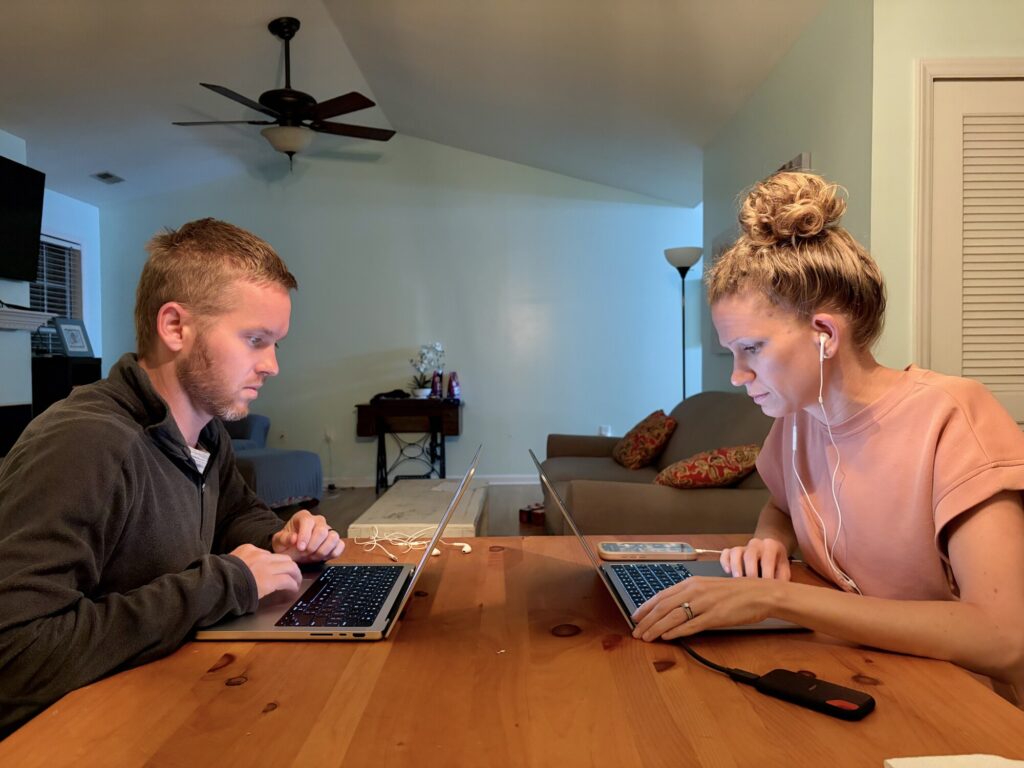
The answer wasn’t making one huge financial decision. It was giving every paycheck a job before it ever hit our checking account.
One thing I want to make really clear is that we didn’t stop investing for retirement so we could save for travel. We were building both at the same time.
Every paycheck was automated.
We contributed to our 401(k)s first because retirement was still one of our long-term priorities. As our debt disappeared and our income increased, we eventually maxed out both of our retirement accounts. We also contributed to our HSA and invested those funds because we wanted that money working for us too.
Later, after our daughters were born, we opened 529 plans for both of them. Eventually we added brokerage accounts as well.
I’m sharing this because I don’t want this article to sound like we ignored every other financial goal just to travel. We didn’t. We were building the foundation first while also creating the flexibility to leave later.
The turning point came when we reached Coast FI.
At that point, we knew our retirement accounts had enough time to continue growing on their own without us needing to contribute at the same pace. That completely changed what we could do with our income.
Instead of aggressively putting thousands of dollars into retirement every month, we redirected those dollars into our Freedom Fund. Suddenly our travel runway started growing much faster because the financial foundation was already there.
We also kept every major goal separate.
Our retirement accounts had one purpose.
Our Freedom Fund had another.
Our emergency fund had another.
For us, an emergency fund meant six months of living expenses if we both lost our jobs. We built ours to about $40,000, and that money was never part of our travel budget. Knowing it was there gave us confidence because we weren’t risking our family’s financial security just to take a year off.
The other thing that made this work was automation.
I’ve always believed that if you’re waiting until the end of the month to see what’s left to save, you’ll almost always save less than you intended.
We paid ourselves first.
Every paycheck automatically moved money into the accounts it was supposed to go to before we ever had the chance to spend it. We didn’t rely on motivation, and we didn’t have to make the same decision over and over again every payday.
Then, once a month, we’d sit down together and look at everything.
Not every day. Not every week. Just once a month.
We’d review where our money had gone, whether we were staying on track, and if anything needed to change. Those meetings weren’t about judging ourselves. They were simply a way to make sure our spending still matched the goals we had set.
Looking back, I think that’s what people often miss when they ask how we saved $100,000.
They expect there to be one big trick.
There wasn’t.
It was a financial system that quietly repeated itself every single payday. Every account had a purpose. Every dollar had a destination. Over time, those small, consistent decisions turned into the financial runway that eventually allowed us to leave.

Stop Optimizing the Wrong Expenses
This is probably where I disagree with a lot of traditional budgeting advice.
People love to talk about cutting out coffee, skipping avocado toast, or finding another subscription to cancel. And while I understand the point they’re trying to make, I don’t think that’s where most high-income families are going to make meaningful progress.
Can little purchases add up?
Absolutely.
A thousand small cuts are still a thousand cuts.
But if you’re serious about building a travel runway, you have to look at the expenses that are taking thousands of dollars out of your budget every single month. Those are the decisions that move the needle.
The first one is housing.
How much are you spending on your mortgage or rent? What about property taxes, insurance, utilities, maintenance, and everything else that comes with owning a home? More importantly, is your housing aligned with the life you’re trying to build, or is it simply the house you felt like you were supposed to buy?
That’s a hard question because for many of us, a home is tied to success. It certainly was for us. But looking back, I realize we spent a lot of time trying to build a house that fit our life instead of asking whether our life still fit the house.
The next big expense is transportation.
When my husband and I bought our cars, he qualified for 0% financing and mine was 1.9%. Because my interest rate was higher, we focused on paying my car off first while letting his continue on the 0% loan. It wasn’t a huge financial hack. It was simply making sure our money was working where it had the biggest impact.
We also didn’t keep upgrading our cars. Once they were paid off, we kept driving them. Not because we couldn’t afford something newer, but because the cars were already doing exactly what we needed them to do.
Then there are vacations. This is one I don’t think people talk about enough.
It’s very easy to spend $10,000 or $15,000 on a weeklong vacation because it’s framed as something you’ve earned after working hard all year. And there’s nothing wrong with taking vacations. We still believe experiences are worth spending money on.
What changed for us was asking whether we’d rather spend that money escaping our life for a week or building a life we didn’t constantly feel the need to escape from.
That question completely changed how we thought about travel.
Insurance is another expense that deserves attention. Whether it’s health insurance, homeowners insurance, auto insurance, or life insurance, understand what you’re paying and why you’re paying it. Some costs are unavoidable, especially in the United States, but they’re still part of your financial picture and deserve to be reviewed instead of ignored.
The same goes for eating out.
For a family of four, it’s easy to spend $100 on dinner without thinking twice. Do that a few times a week, and suddenly you’ve created another large monthly expense that probably isn’t bringing the same long-term value as your bigger goals.
Now, after saying all of that, I’m going to tell you something that might surprise you.
We never stopped buying coffee. If we wanted to grab coffee together on a Saturday morning, we did.
I wasn’t interested in building a financial plan that made us feel guilty over five dollars while completely ignoring the decisions costing us thousands every month.
That’s the difference.
Once the big financial decisions were aligned with the life we wanted, I stopped worrying so much about the little ones.
This was never about surviving on ramen noodles or saying no to everything that made life enjoyable. It was about being honest about which expenses were actually moving us further away from our goals and which ones simply made life a little nicer.
For us, the answer was almost never the coffee.
It was the decisions we only made every few years but lived with every single day.
Earning More Helped, but It Wasn’t the Reason We Got There
One of the questions I get all the time is whether we simply earned our way to $100,000.
The answer is yes…and no.
Of course earning more helped. If an opportunity came up to make extra money, we usually took it. In medicine that meant picking up extra shifts when it made sense and earning quarterly bonuses based on productivity. Those bonuses didn’t automatically become spending money. They went toward our bigger goal.
We also looked for money that was already available to us. If we sold something we no longer used, that money went into the Freedom Fund. If we received a tax refund, it didn’t disappear into everyday spending.
We focused more on travel points than cash back because we knew flights would eventually become one of our biggest expenses. Every point we earned was one less dollar we’d have to spend later.
Those things absolutely helped us build our runway faster. But if I’m being honest, I don’t think earning more was the biggest reason we reached our goal.
I think that’s where a lot of people get stuck.
The assumption is that another raise, another side hustle, or another stream of income will solve the problem. Sometimes it does. But if your spending continues to grow every time your income grows, you’re still standing in the same place.
For us, the biggest gains came from learning how to direct the income we already had.
Every extra dollar had a purpose before it ever reached our checking account. Bonuses weren’t permission to spend more. Raises didn’t automatically mean upgrading our lifestyle. They meant we could shorten the timeline to the life we were trying to build.
I also think there’s an important distinction between being frugal and being intentional.
I never wanted to become the person who questioned every purchase or felt guilty for spending money. That isn’t sustainable, and it isn’t how I wanted to live.
Instead, I wanted to know that the big decisions had already been made well.
Once we had done that, I didn’t feel bad buying coffee, taking my girls somewhere fun, or spending money on healthy food. Those purchases aligned with the life we were trying to create.
What I didn’t want anymore was mindless spending. The kind where money disappears simply because it’s there.
Looking back, I don’t think we saved $100,000 because we earned extraordinary incomes.
I think we saved it because we stopped letting extraordinary incomes quietly disappear into ordinary spending.
That was the difference.
The Mistakes That Slowed Us Down
The biggest thing that slowed us down was not knowing where to start.
We came out of school with debt, were planning a wedding, trying to build a family, and eventually paying for infertility treatment. We had good incomes, but there were so many financial goals competing for our attention that we did not know which one should come first.
I know some people hear that and think having a good income with too many options is not really a problem. But when you have spent years in school without earning much, then suddenly start making money while also trying to pay for everything that was delayed during those years, it can feel overwhelming. You are paying off the past, trying to enjoy the present, and preparing for the future all at once.
For a while, we were simply putting money in several different directions without a clear order. We were making progress, but probably not as quickly as we could have because we had not decided what our main goal was yet.
That changed once we became more specific about what we wanted our life to look like. When the goal became clear, it was much easier to decide where our money should go and what could wait.
Another decision we would not make again, at least in this season of life, is buying another house.
I know homeownership is often presented as one of the main ways to build wealth, and it can be. But a house also comes with property taxes, insurance, maintenance, repairs, and a long list of expenses that do not always make it feel like an asset while you are living in it.
A house only becomes an asset when you are able to sell it for more than you have put into it, and that depends on the market, how long you stay, and how much money you spend maintaining it along the way. For the kind of flexibility we want now, taking that on again does not make sense for us.
That does not mean buying a house is the wrong decision for everyone. It means it no longer fits our current goals.
We also thought building a $100,000 travel runway would take much longer than it did. Once we stopped dividing our attention between too many priorities and started consistently directing money toward one specific goal, the progress accelerated.
What surprised me most was not just that we reached the number. It was how much better the decision worked for our family than I expected.
I wish we had understood financial freedom sooner, not only as something connected to retirement, but as a way to create more options while we were still young. There are so many ways to use money to buy back your time, change the way your family lives, and create room for something different.
We probably could have reached this point sooner if we had understood that earlier. But I am also glad we figured it out when we did instead of spending another decade waiting for the right time.

What We Never Stopped Spending Money On
One thing I don’t want this article to leave you with is the idea that we stopped spending money on everything we enjoyed.
We didn’t.
In fact, I think that’s one of the biggest misconceptions about saving for a goal like this. People assume you have to put your life on hold for two years, say no to everything, and then eventually you’ll get to enjoy it. That was never our approach because I don’t think it’s sustainable.
Instead, we became much more intentional about what was worth spending money on.
Our daughters stayed in activities they loved because those experiences mattered to us. We never looked at them as something we needed to cut just to reach a savings goal a little faster.
The same was true with food. We continued buying healthy, organic food whenever we could because that aligned with our values. Could we have spent less? Probably. But not every expense should be minimized simply because it costs more.
We’ve also always chosen experiences over things.
Long before we ever left to travel, we’d rather spend money making memories together than filling our house with more stuff. That mindset didn’t start when we boarded our first international flight. It was something we were already practicing while we were building our travel runway.
Looking back, I think that’s an important distinction. We weren’t sacrificing the life we wanted in order to save for another one. We were already living according to our values. We simply stopped spending as much on the things that didn’t align with them.
That’s why I don’t believe budgeting is about cutting everything equally. It’s about deciding what matters most and protecting those things while being willing to let go of the expenses that don’t.
For our family, time together mattered. Our health mattered. Experiences mattered. Everything else became much easier to evaluate because we had already decided what we wanted our money to buy.
Before you start building your own travel runway, I’d encourage you to answer that question for yourself.
What are the things you’re not willing to give up?
Because once you know that, you can stop feeling guilty about spending money on them and instead focus your attention on the expenses that are actually standing between you and the life you’re trying to create.

What Saving $100,000 Actually Bought Us
People often say, “That’s amazing that you saved $100,000 so you could travel for a year.”
They’re right, but I also think they’re missing what that money actually bought.
The travel was simply the result.
What it really bought us was the ability to make a different decision with our lives.
For the first time, we weren’t making decisions based on when we had to be back at work or how many vacation days we had left. We had the financial runway to slow down, spend more time together as a family, and choose destinations based on how we wanted to live instead of how quickly we could fit them into a seven-day vacation.
It also gave us confidence.
Not because we had a certain amount of money sitting in a bank account, but because we had proven to ourselves that we could build something that once felt completely out of reach. We understood our finances better than we ever had before. We understood how to create a goal, build a system around it, and trust ourselves to follow through.
That confidence carried into every other area of our lives.
It’s a big part of the reason we eventually started building a business. Once you realize you can intentionally design one part of your life instead of simply accepting it, you start asking where else you’ve been living on autopilot.
The biggest gift, though, was time. Time with our daughters while they still wanted to hold our hands. Time to experience different cultures together instead of talking about doing it “one day.” Time to slow down enough that our days stopped feeling like something we were trying to survive until the weekend.
Looking back, I don’t think I was ever chasing a year of travel.
I was chasing a different way of living.
I didn’t want to spend the next thirty years working toward a retirement date before giving myself permission to enjoy my life. I also didn’t want the most interesting thing about me to be the career I had or the number of years I worked.
I wanted my daughters to remember that we built a life around what mattered to us instead of simply accepting the version that was handed to us.
I wanted to be able to say we took the chance while we could.
That’s what the $100,000 bought.
It bought us the opportunity to choose.
And looking back, I don’t think that’s something you can put a price on.

Could You Do the Same Thing?
By now you’re probably wondering whether this is something your family could actually do. I think that’s the wrong question. A better question is, “What would it take for us?” Because your answer is almost certainly going to be different than ours.
You may not need $100,000. You may need more. You may need less.
It depends on where you want to travel, how long you want to be gone, whether you’ll keep paying for a home back in the United States, how often you plan to move, and what kind of lifestyle you want while you’re away.
That’s why I don’t recommend picking an arbitrary savings goal. Start by understanding the life you’re trying to build.
Where do you want to go?
How do you want to travel?
How long do you want to be away?
What expenses will still exist at home?
Once you answer those questions, your runway starts becoming much easier to calculate. If all of that feels overwhelming, don’t worry about having the entire plan figured out today. We certainly didn’t. When we first started, we weren’t thinking about international health insurance, visas, worldschooling, or building a business while traveling. We were simply trying to take the next step.
That’s really all you need to do. Know where you are today. Know where you want to go. Then figure out what the next bridge is between those two places.
Maybe that’s paying off debt. Maybe it’s building your emergency fund. Maybe you’ve already reached Coast FI and now it’s time to start building your own Freedom Fund.
Whatever it is, focus on that one goal until it’s complete before trying to build the next bridge.
Looking back, that’s one of the biggest lessons this entire journey taught me. You don’t create a completely different life by solving every problem at once. You create it by solving the next one.
If you’re trying to figure out what your own travel runway looks like, we’ve built a free Travel Runway Calculator that does exactly that. You can adjust your travel style, budget, and timeline to estimate how much you’ll need and how long it may take to get there.
My hope isn’t that you save exactly what we did. It’s that you become intentional about what you’re asking your money to do. Because once your finances have a purpose, every decision gets a little easier. And sometimes the biggest change isn’t earning more money.
It’s finally giving the money you already have somewhere meaningful to go.
Frequently Asked Questions
How long did it take you to save $100,000?
It took us about two years after reaching Coast FI. Once we knew our retirement investments were on track, we redirected thousands of dollars from each paycheck into our Freedom Fund, which accelerated our timeline significantly.
How much did you actually spend during your year abroad?
Our family of four spent approximately $37,000 on living expenses and about $9,000 on flights, many of which were reduced through travel points. We intentionally built a much larger runway because we wanted flexibility, not just enough money to scrape by.
Should you pay off debt before traveling?
For us, yes. We wanted to leave without debt hanging over our heads so we could fully enjoy the experience instead of worrying about payments waiting for us back home.
How much emergency savings did you have?
Our emergency fund was completely separate from our travel runway. We built it to approximately $40,000, which represented about six months of living expenses if we both lost our jobs.
What’s the fastest way to save for long-term travel?
Start with a specific goal. Automate your savings so every paycheck has a purpose, review your progress once a month, and focus on the financial decisions that have the biggest impact. You don’t have to make perfect decisions, you just need a system that consistently moves you closer to the life you’re trying to build.
More on the Blog:
How Much Does It Cost to Travel for a Year With a Family
What’s the Best Age to Travel With Kids?
How to Convince Your Partner to Travel Long Term With Kids When They’re Not On Board