One of the questions we get asked most is, “How do you afford long-term family travel?”
People assume there has to be a secret.
Maybe we’re rich. Maybe we retired early. Maybe we’re living off investments or earning a massive passive income while traveling the world with our kids.
The truth is much less exciting.
We have been traveling full-time as a family since September 3, 2024. Over the last 22 months, we’ve lived in 10 countries, moved through multiple regions within them, and built a life that looks completely different from the one we left behind.
But the way we afford full-time family travel today isn’t the same as how we afforded it when we first boarded that plane.
In the beginning, our travels were funded almost entirely by savings. Today, our family is supported by a combination of active and passive income streams that we’ve spent the last two years building. Neither happened overnight, and neither was the result of finding one magical way to make money online.
Instead, we slowly built a life that costs less to live, gave ourselves enough time to figure out what came next, and created a financial system that has allowed us to keep going.
That’s the part I think gets missed.
Most conversations about how to afford full-time family travel focus on making more money. While income certainly matters, we’ve learned that sustainability comes just as much from understanding what your life actually costs and building a lifestyle that fits within it.
In this article, I’ll walk you through exactly how we’ve funded nearly two years of long-term family travel, how our strategy has evolved over time, and the biggest lessons we’ve learned about creating a lifestyle that doesn’t end when the savings account does.
We Didn’t Leave With a Business or Remote Income
One of the biggest assumptions people make is that we must have had an online business or remote jobs before we left.
We didn’t.
My husband and I both spent our entire careers in medicine. I started as a nurse before becoming a physician assistant, working in trauma critical care before eventually transitioning to emergency medicine. Steven also worked as a physician assistant, first in urgent care and later in emergency medicine.
Neither of us had remote work available, and we knew that wasn’t the life we wanted to keep building anyway.
We had never built an online business. We had never made money from social media, affiliate marketing, blogging, digital products, or brand partnerships. None of that existed when we boarded our first flight.
The only income we had was from a long-term rental property in Arizona, and even that wasn’t generating meaningful income yet. We had recently completed a major renovation, so at the time it was mostly covering its own expenses while we worked toward recovering what we had invested.
So why would we leave without knowing how we were going to make money later?
Because we knew exactly what we wanted to leave behind, even if we didn’t know what came next.
We weren’t leaving because we had every answer. We were leaving because we had spent years building enough financial runway to give ourselves something we had never really had before: time.
We had saved $100,000, and our plan was simple. Slow down. Travel together as a family. Live within that runway while we figured out what we wanted the next chapter of our lives to become.
There was no guarantee it would work.
No business waiting for us.
No replacement income already in place.
Just enough time to stop running on autopilot and finally build a life that felt worth returning to every day.

We Used Savings to Fund Our First Year
The biggest thing that made our first year possible wasn’t a remote job or an online business.
It was savings.
Before we left, we had built what we called our freedom fund, $100,000 that was completely separate from our retirement accounts and intended for one purpose: giving our family the time and space to build a different life.
That money wasn’t random. We had spent years saving it because we assumed our gap year would cost around $100,000. Looking back, that estimate came from what our life in the United States was costing us, not what long-term travel would actually cost.
During our first year abroad, we spent about $37,000 on living expenses and another $9,000 on 14 flights for our family of four.
So where did the rest of the money go?
Our house.
When we first left, we didn’t immediately sell it. We held onto it for about six months and only rented it for roughly six weeks through Airbnb. While the rental income allowed us to break even during those stays, it wasn’t a sustainable setup for our property.
We absolutely loved that house, but it wasn’t an easy home to rent consistently, and eventually we realized holding onto it no longer made sense for the life we were trying to build.
By the time we sold it, we had spent roughly another $20,000 simply maintaining it while we were gone.
I think this is one of the biggest financial mistakes families can accidentally make when planning long-term travel.
Everyone focuses on what travel will cost, but very few people calculate what it costs to keep their life at home running at the same time.
For us, living abroad wasn’t what was draining our savings.
Holding onto our life back home was.
I’ll be honest, that created a lot of pressure.
Even though our day-to-day travel expenses were much lower than we expected, watching our savings disappear because of a house we weren’t living in made me feel like we needed to figure out how to make this lifestyle sustainable before our runway disappeared.
The Goal Was Never to Replace Two Medical Salaries
Together, we earned around $200,000 a year working in medicine, and at first, it felt like we needed to replace a significant portion of that income to keep traveling.
But that was mostly because we were still paying for parts of our old life.
Once we sold the house, lowered our expenses, and stopped trying to support two completely different lifestyles, the number we actually needed became much clearer. Our family could live comfortably abroad for around $3,000 a month.
That changed the question from, “How do we replace two medical salaries?” to, “How do we support the life we are living now?”
Trying to recreate a $200,000 income in a completely different career would have placed an enormous amount of pressure on us. We had spent years building specialized careers, and walking away from them made it easy to believe that anything new had to immediately produce the same amount.
It didn’t.
We no longer needed to fund the expensive structure of our old life. Once our monthly living expenses stabilized around $3,000, our definition of enough changed with it.
It Took Almost a Year to Build Meaningful Income
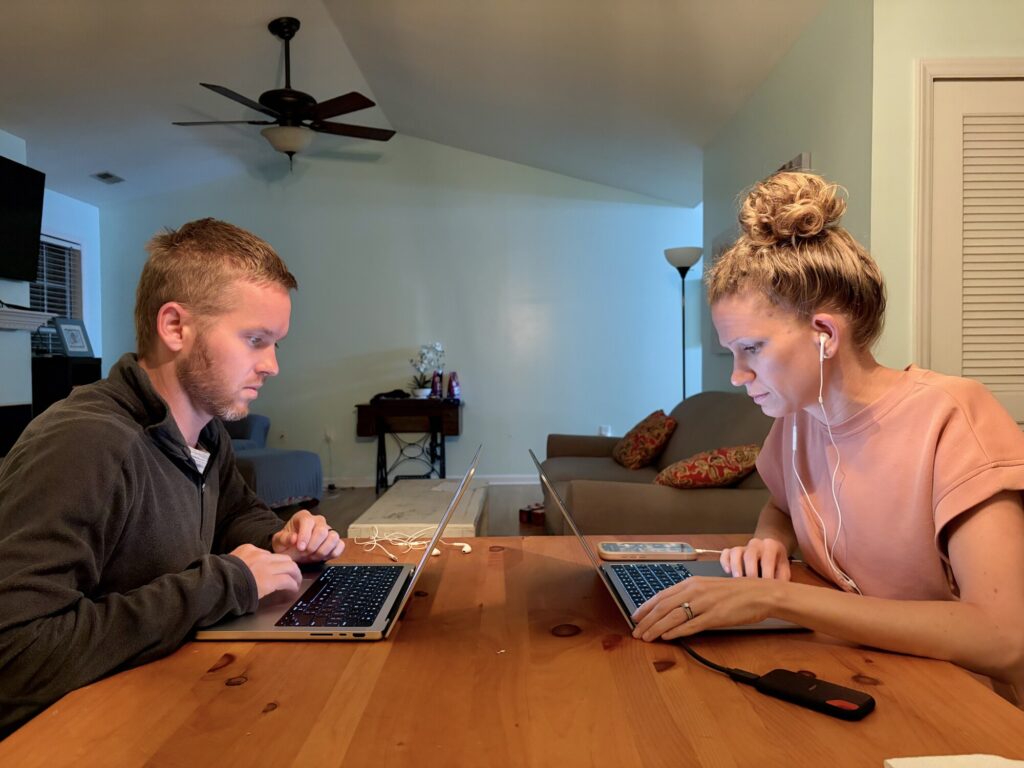
We did not seriously begin trying to build an online business until around August 2025, almost a year after we left.
Before that, I had been sharing our life online and experimenting with different ideas, but eventually I realized that if we wanted this to become a meaningful source of income, I needed to treat it differently. I joined a content creation course, started learning how the online business world actually worked, and we began building multiple income streams through brand partnerships, affiliate marketing, social media, and our blog.
We knew it would not happen immediately.
There were months when we made around $800, with some additional income coming from brand work and our rental property. Our savings continued to protect us while we learned how to make the business more consistent and sustainable.
And there was a lot to learn.
We taught ourselves videography, photography, editing, blogging, pitching brands, marketing, and even AI and coding. We invested in courses, software, equipment, and mindset coaching because we quickly realized that building a business required us to grow personally just as much as it required us to develop new technical skills.
Behind the scenes, we were probably working more than we had in medicine because we were learning so many things at once. It just did not feel the same because we were building something of our own and could decide when, where, and how the work happened.
If we had expected the business to immediately replace our medical salaries, we never would have made it this far. We had to lower the expectation of what the business needed to earn at the beginning and give it time to grow into something that could support us long-term.

We Built More Than One Layer of Financial Security
One reason this lifestyle has remained sustainable is that we never relied on one account, one investment, or one income stream to hold everything together.
We still maintain a $40,000 emergency fund, the same type of fund we once kept in case either of us lost a job. We also build a 15% to 20% buffer into our monthly spending so that going over budget does not immediately create a financial problem.
Our retirement money has always remained completely separate from our travel money. Because we had already reached beyond Coast FI before leaving, our invested accounts continued growing while we traveled. Between our 401(k)s, brokerage accounts, and HSA, our invested assets eventually crossed $1 million while we were abroad.
We do not use those accounts to fund our day-to-day life.
Instead, we manage irregular business income by maintaining several active and passive income streams, including our rental income. No single stream has to cover everything every month. When they are combined, they support the life we have built.
We also keep money aside for taxes and work with a tax advisor because being outside the United States does not eliminate our U.S. tax responsibilities. For medical emergencies abroad, we carry travel medical insurance.
These layers are what keep one slower business month, unexpected expense, or medical problem from immediately forcing us to return home. Long-term family travel became sustainable because we did not build it on one fragile source of security.
A Good Income Does Not Automatically Make Long-Term Travel Sustainable
Having a good income does not guarantee that your family will be able to keep traveling.
From what I have observed, most families tend to approach long-term travel in one of two ways. Some continue working full-time for someone else, which allows them to live almost anywhere, but they are still working the same nine-to-five schedule in a prettier location. The scenery changes, but their time and daily life often do not.
Other families save a set amount of money, travel as much as possible while they have it, and return home when it runs out. That can still be an incredible experience, but it was always designed to end.
Neither approach is wrong. But neither one necessarily changes the financial structure of the life waiting for them at home.
The middle ground is building a setup that allows your money, income, and schedule to work together. That might include savings, active income, passive income, investments, or a combination of several streams. The goal is not simply to earn enough to travel. It is to create enough flexibility that you can actually spend time with your family while you are doing it.
And if you plan to live entirely from savings, you still need to understand how long that money will last and whether there is another income stream helping to extend it. You also have to slow down enough that your life abroad does not feel like a never-ending, once-in-a-lifetime vacation.
Before leaving, you need to know what your life at home is costing you, which expenses will continue after you leave, and what your realistic monthly burn rate will be while traveling.
A strong salary can fund long-term travel, but without those numbers and a sustainable structure behind it, even families with good incomes can eventually find themselves going home.

How Another Family Can Build Its Own Version
You do not need to copy our exact financial structure to make long-term family travel work, and I cannot tell you which path is right for your family. But there are several ways families can build a version that fits their income, timeline, and comfort level.
Some families reach financial independence and live from their investments based on a planned withdrawal rate. Others take a sabbatical for several months, use savings, and return to work with the intention of repeating that pattern again later.
One parent may continue working remotely with a flexible schedule, while another family may rent out its home in a way that operates like a sustainable business. Some families travel seasonally instead of full-time, and others begin with three months because an entire year feels too big.
You do not have to commit to forever to find out whether this life works for you.
Before leaving, calculate what your current life costs at home, which expenses will continue while you are gone, and how much you realistically expect to spend abroad. Then choose destinations, accommodations, and a travel pace that fit that number instead of building a route first and trying to force the budget around it.
I would also build at least a 20% buffer above your expected costs. Your runway should account for both the expenses you are keeping at home and the cost of living abroad for the full amount of time you plan to travel.
Most importantly, test the life before making a permanent decision. Travel for a month. Try three months. Take a sabbatical if that is available to you.
You do not have to jump off the edge and hope everything works. You can build confidence by proving each part of the plan to yourself first.

The Real Reason We Can Keep Going
The biggest reason we can keep traveling is not because we are earning more than we did before.
It is because we have built a life that costs less and can be sustained month after month.
We have let go of a lot of what we once believed success was supposed to look like. For us, it is no longer about lifestyle inflation, earning the highest salary possible, or living in one place because we were told it was the best place to build a life.
It is about finding places that fit our family, spending more time together, and building a life that feels like ours instead of following someone else’s version of what it should look like.
A large salary and freedom can exist together, and if you have both, that is incredible. But earning more does not automatically mean you have more freedom, and you do not have to replace your old income for long-term family travel to become possible.
What matters is finding a sustainable way to support the life you actually want.
That also means deciding whether your goal is to travel forever or to build enough freedom that you can keep choosing what works for your family. For us, it has always been about the ability to choose. We say we are traveling indefinitely because that is what works right now, but we are willing to change the pace, the location, or the structure whenever our family needs something different.
We did not make long-term family travel sustainable by finding one magical source of income. We lowered the cost of the life we wanted, gave ourselves enough time to build new income, and created a system we could repeat without constantly starting over.
That is the reason we are still here nearly two years later.
More on the Blog:
How We Prepared Financially Before our Gap Year