The biggest question almost every parent asks when they start thinking about taking a year abroad with their kids is:
How much money do we actually need to travel for a year as a family?
Unfortunately, there isn’t one right answer. There isn’t even an easy answer.
I know that is probably not what you want to hear.
You probably want someone to tell you that a family of four needs $50,000, $75,000, or $100,000 for a year abroad so you can finally figure out whether this is something your family can actually afford.
We wanted the exact same thing.
Before we left to travel full-time with our two young kids, we assumed we needed $100,000 to travel for one year. We spent years saving that amount because it was the number that made leaving our jobs and taking our kids abroad feel responsible.
Then, after 12 months of long-term family travel, I finally sat down and looked at what we had actually spent.
Our family of four spent $37,000 on living expenses for the entire year and another $9,000 on flights.
We had saved $100,000.
We spent $46,000.
We were off by $54,000.
But even after traveling full-time with our kids for more than a year, I still can’t tell another family, “You need $46,000 to travel the world for a year.”
Because your family gap year cost could look completely different from ours.
If your dream is to spend a year traveling through Western Europe or living in places like Switzerland or Uruguay, your long-term family travel budget will probably be higher than ours. We spent most of our first year in Central America, India, and Southeast Asia, where our money stretched much further.
Where you go matters.
But it is only one part of the equation.
How you travel matters just as much.
For us, long-term travel means anything over three months. And one of the most surprising things we have learned is that the longer you travel, the lower your average monthly spending can become.
That sounds completely backward.
Most families assume that if a one-month international trip costs $10,000, then traveling for an entire year must cost $120,000.
But a one-month vacation and a year abroad with kids are not the same thing.
When you only have a week or two, you are usually trying to make the most of every day. You move faster. You book short-term accommodations. You eat out more. You pay for more activities. You visit the major attractions. You might rent a car because it is easier. And because you only have a limited amount of time, you are willing to spend more to make the trip count.
You cannot live like that for an entire year.
And you do not need to.
When you travel long-term, you can slow down. You can stay in one place for a month or longer. You can rent an apartment instead of a hotel room, cook at home, shop at local markets, use public transportation, find free parks and playgrounds, and build an actual daily life somewhere.
That is the part I did not understand before we left.
A year abroad is not one very long vacation.
It is your real life taking place somewhere else.
And once you understand that, the question changes from:
“How much money do I need to travel for a year?”
to:
“How much does my family realistically need to live abroad for a year?”
Those are two completely different numbers.
And if you are planning a year abroad as a family of four or more, you also need to think differently than a solo traveler or a couple.
As soon as you add kids, your needs change.
Two adults might be perfectly happy sharing a tiny room, taking a 14-hour overnight bus, or staying somewhere without a kitchen or washing machine.
A family with young kids may need two bedrooms. You might need a kitchen because eating every meal at a restaurant is exhausting. You may need a washing machine because kids somehow go through three outfits a day. You may care more about walkability, nearby grocery stores, parks, healthcare, and whether your neighborhood actually works for everyday family life.
That doesn’t mean traveling with kids has to be expensive.
It means your family travel budget needs to be built around the way your family will actually live.
So no, there is no magic number for how much it costs to travel for a year with a family.
But there is a way to figure out yours.

There Is No Magic Number for a Family Gap Year — Only a System
There is no perfect number that works for every family because every family is completely different.
If every family wanted the exact same year abroad, we would all be going to the same countries, staying in the same neighborhoods, booking the same accommodations, and spending money on the same things.
And honestly, while we might all meet up in the same place at some point, our setups would probably look completely different.
One family might need a three-bedroom apartment because their kids need separate sleeping spaces. Another might be perfectly comfortable in a small two-bedroom. One family might prioritize childcare or international school, while another homeschools. One might eat out every day, while another wants a kitchen and cooks most meals at home.
That is why copying someone else’s long-term family travel budget will only get you so far.
The biggest factors that change the cost of traveling for a year with a family are accommodations, transportation, location, pace, food, and lifestyle.
Accommodations can get expensive very quickly when you move often. Shorter stays tend to come with higher nightly rates and more frequent fees. Every time you move, you may be paying another cleaning fee, service fee, transfer, and sometimes another gap between check-in and check-out.
Flights can also become one of the biggest expenses in a family gap year budget, especially when you are flying everywhere because you need to reach the next destination as quickly as possible.
When you have a limited amount of time and a long list of places you want to see, you pay a premium for speed.
Location matters too.
If you spend your year in Western Europe or choose places that are trending, popular, and attracting everyone else at the same time, your costs will likely be higher.
That does not mean you cannot go to those places.
It means where you go, when you go, and how long you stay will affect your budget.
Then there is lifestyle.
Are you paying for convenience everywhere you go?
Or are you learning how to do more things on your own?
That question can completely change how much money your family needs to travel for a year.
A system is far more useful than copying someone else’s exact budget because a good system helps you figure out what works for your family and repeat it over and over again.
We use the same framework every time we choose a destination, find housing, plan transportation, and set up our daily life abroad.
The framework can work for almost any family.
But first, you have to learn how it works for yours.

Long-Term Travel Is Not One Long Vacation
When families treat a year abroad like a vacation, that is exactly how it is going to turn out.
Think about how most of us take vacations.
You are there for a limited amount of time, so you have to fit everything in. Every day is planned. You need to see this, do that, eat there, book the tour, and make the most of every second because this might be a once-in-a-lifetime opportunity.
So you spend to make it count.
Your money goes faster. Your time goes faster. And before you know it, you are home because you either ran out of money or ran out of time.
You cannot live that way for an entire year.
Life abroad looks completely different.
For us, it means taking the life we had at home, flipping it on its head, and making it better. Not because we are on vacation, but because we finally have more time for the things that matter to us.
We have more time with our kids. More time for ourselves. More time to work on things that are important to us. More time to find hobbies, eat better, exercise, and build a daily life that actually feels good.
That is life abroad.
It is your life now, but better.
And not because every day is filled with bucket-list experiences. It is better because you have created more space to focus on your family and what actually makes your family better.
Once you stop trying to do everything, your spending changes too.
You walk more. You shop at local markets. You eat at home. You experiment with new foods and routines. You spend afternoons at parks and playgrounds. You go to local activities and holiday events instead of automatically booking whatever is marketed to tourists.
And sometimes, those experiences end up being better than the ones you would have paid for.
When we were in India, we celebrated Holi in Jaipur.
For many solo travelers and couples, celebrating Holi in India means going to one of the huge organized events where hundreds of people are packed together throwing colored powder into the air.
We did not do that.
We were staying with a local family, and they told us they celebrated Holi in the street outside their home. So that is where we went.
It was their family, their friends, and their neighbors. Everyone threw color on each other, the kids played with water and hoses, and we celebrated together in the street.
It was quiet. Unassuming. Safe enough for our young kids. And one of the most beautiful experiences we had in India.
The family told us the huge Holi parties were mostly for tourists anyway.
This was how they celebrated.
And that is the difference between vacationing somewhere and actually living there.
Of course, your normal expenses do not disappear just because you are abroad.
Everywhere we go, our long-term family travel budget is still built around the same core categories: accommodations, food, activities, transportation, and miscellaneous costs like visas, eSIMs, and healthcare.
Those are the expenses of living abroad.
But when you slow down, many traditional vacation expenses start to disappear.
You stop paying for convenience everywhere you go.
You do not always need a tour guide to shuttle you from one attraction to the next. You do not need someone to plan every day for you. You do not need to stay in a luxury hotel because you are trying to make one week feel special.
The longer you stay, the more you learn how to do things yourself.
And that is when the cost of traveling for a year with a family starts to look a lot less like the cost of a year-long vacation and a lot more like the cost of simply living somewhere else.

Start With How You Want to Live, Not Where You Want to Go
Now that you are actually thinking about your budget, do not start by picking a destination.
Start with how you want to live.
This is one of the biggest things I teach my clients because most families do the exact opposite. They see a country trending online, hear another family rave about a city, or build a list of all the places they have always wanted to go.
Then they try to make their family fit the destination.
Instead, start with the kind of daily rhythm your family actually needs.
For us, we like slow mornings. We enjoy going to local markets and grocery stores. We love finding cute, themed cafés where we can sit for an hour, drink coffee, and hang out together. We want parks and playgrounds nearby. And we want to be able to walk to the grocery store.
Those things might sound small, but they completely shape where we stay and how much we spend.
Think about what your own family needs for daily life.
Do you need walkability? Do you want grocery stores and local markets nearby? Do your kids need easy access to parks and playgrounds? Will you need childcare, reliable healthcare, or public transportation?
Then look at what is actually available in the places you are considering.
Would your family be okay with the transportation system there? Would you be comfortable with the healthcare access? Could you manage without a car? Is the kind of childcare you need available?
Sometimes the answer will be yes.
Sometimes it will not.
And that is exactly why you need to think about these things before choosing where to go.
You also need to think about how you actually like to spend your money.
How often do you want to eat out?
For us, eating out often means going to a café. My husband and I love coffee, so every other day or every three days, we find somewhere we want to try. We get coffee, the kids get a little dessert or croissant, and we sit there together for an hour or so.
That is something we genuinely enjoy, so it belongs in our budget.
Then think about how often you want to move.
For us, we typically change locations about every four weeks. Sometimes we stay a little less. Sometimes we stay longer. But on average, we move about once a month.
Then ask yourself what you are actually prioritizing.
Do you want comfort? Adventure? Convenience? Or the lowest possible cost?
For us, it is comfort and a very specific kind of convenience.
We are not paying for convenience because we need someone to plan our lives, shuttle us around, or handle everything for us.
We pay for the convenience of having the things that matter to our daily life within walking distance.
A grocery store nearby matters to us.
Parks and playgrounds matter.
Cafés matter.
Being able to walk out the door and live our daily life without constantly arranging transportation matters.
We learned that this is what works for our family of four with two young kids.
Your version might look completely different.
Finally, ask yourself one of the most important questions when planning a year abroad with kids:
What would make this year feel sustainable instead of stressful?
For us, it is having a realistic budget and making sure the things I listed above are in place.
That is what makes long-term travel work for our family.
So before you search for the cheapest countries to travel with kids or build your route around the places everyone else is going, answer these questions for yourself.
Because once you know what your family actually needs, you stop chasing trending destinations.
You start choosing places based on your family.
The Main Categories in a Long-Term Family Travel Budget
Once you know how your family wants to live, you can start building your actual budget.
For us, almost everything we spend while traveling long-term fits into the same main categories: accommodations, food, transportation, activities, and miscellaneous expenses.
The exact numbers change from country to country, but the system stays the same.

Accommodations
Our family of four currently aims to spend about $1,200 a month on accommodations out of our $3,000 monthly living budget.
I like to keep housing under 50% of our total budget.
Once your accommodations take up more than half of your monthly spending, it becomes much harder to stay within your overall budget. You still need to eat, get around, pay for activities, and cover the normal costs of daily life.
That does not mean we never spend more than $1,200 on housing.
It means that if we do, we know something else in the budget will need to change.
Groceries and Eating Out
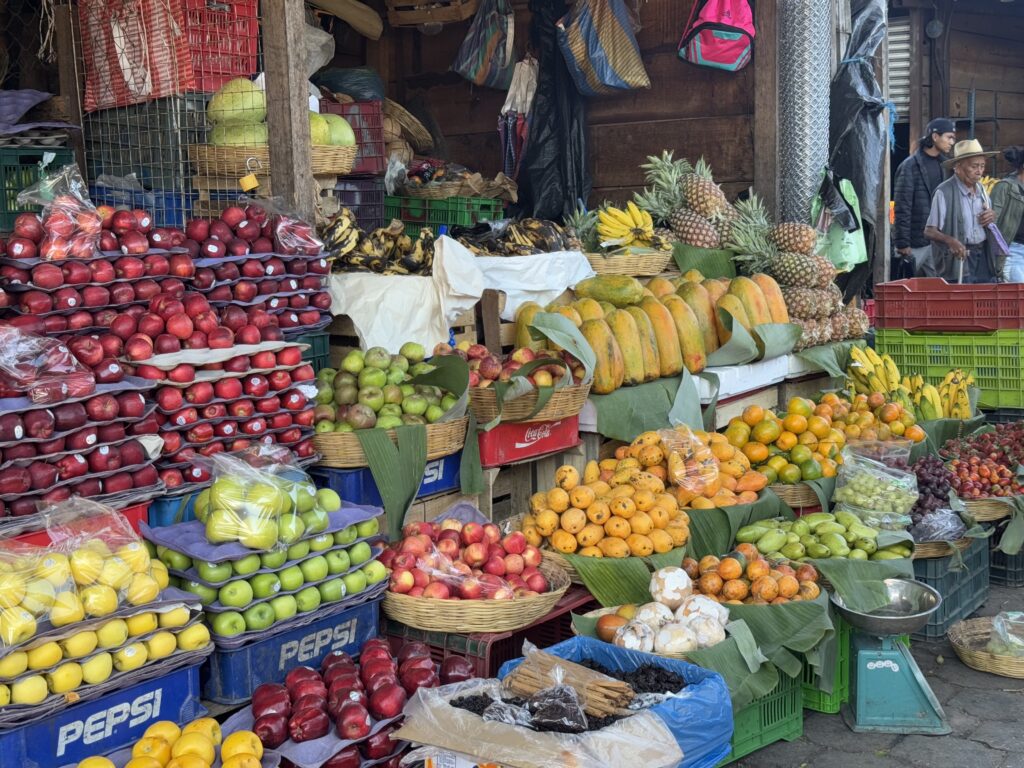
We typically spend more on groceries than we do at restaurants because we cook most of our meals at home.
When we do go out, we often spend our money at cafés.
My husband and I love coffee, the kids are happy with a croissant or a little dessert, and it is something we genuinely enjoy doing together. It is also usually much more affordable than taking a family of four out for a full restaurant meal every day.
Your food budget does not need to look like ours.
But you do need to be realistic about how your family actually eats.
If you hate cooking and know you will eat out twice a day, build that into your budget from the beginning.
Do not create a budget based on a version of your family that does not exist.
Transportation Beyond International Flights
I separate international flights from our monthly living expenses because flights require a different type of research. The cost depends heavily on your route, how often you fly, the time of year, and whether you use points and miles.
For your monthly budget, think about how you will move between destinations and how you will get around once you arrive.
Will you take buses or trains between cities? Will you need a rental car? Is there reliable public transportation? How often will you use it?
Even small choices matter.
Can you use a shared ride instead of booking a private taxi? Can you take the metro instead of arranging a driver? Can you walk to the grocery store instead of paying for transportation every time you need food?
These are the transportation costs that show up again and again throughout a year abroad.

Activities and Experiences
Activities are typically one of our lowest spending categories.
We do a lot of free activities, public spaces, local events, parks, markets, playgrounds, and experiences that are part of everyday life in the place where we are staying.
But your family might be different.
Maybe you chose a destination because there is one major experience you have always wanted to do.
Do it.
A lower-cost month can absolutely include one big experience that is high on your list. The important thing is understanding that you probably cannot spend that way every single month and still expect to stay within the same yearly budget.
Your budget should make room for the things that actually matter to your family.
Insurance, Visas, eSIMs, Laundry, and Emergency Costs
Then there are the expenses that are easy to forget when calculating how much it costs to travel for a year with a family.
We pay the same amount for travel medical insurance every month: $112.
Visas vary by country, but we estimate around $50 per person on average when a visa is required.
We use an eSIM on our phones and usually have it set up before we arrive.
We also prioritize accommodations with a washing machine so we can do our laundry at home instead of constantly paying for laundry services.
Most of our travel gear is a one-time expense. We would rather buy quality gear once and use it for years than constantly replace cheaper items along the way.
Finally, think about your emergency fund.
For us, the biggest unexpected expenses have been related to healthcare. We have needed emergency medical care while traveling, although our eligible costs were fully reimbursed through our insurance.
Your emergency fund should exist outside the money you expect to spend every month.
The goal is not to predict every expense perfectly.
It is to know your major spending categories, decide what matters most to your family, and give every part of your budget a realistic place to land.

Why Your Pace Matters More Than You Think
I am going to keep hammering this point home until it sticks in your brain:
Moving every few days gets extremely expensive.
If you are constantly changing locations and treating your time abroad like a once-in-a-lifetime opportunity, it does not really matter whether you are traveling for three months or an entire year.
That pace is not sustainable for most families.
And yes, it probably will become a once-in-a-lifetime experience because you may go home after three months having spent $18,000.
If that is what you want and you are completely comfortable spending that amount, there is nothing wrong with it.
But you need to know that moving fast comes with a price.
Every time you change locations, you pay for another bus, train, flight, rental car, or private transfer. You pay for another short-term accommodation. You may pay another cleaning fee or service fee. You leave behind refrigerated groceries, pantry staples, cleaning supplies, and all the little things you bought to make daily life easier.
Then you arrive somewhere new and buy many of them again.
These are the costs that rarely make it into someone’s original family gap year budget, but they add up every time you move.
Staying in one place longer can completely change the cost.
Monthly rentals are often significantly cheaper than booking the same property for a few nights or a week. In some cases, we have seen the cost drop by almost 50%.
It makes sense.
You are filling the accommodation for the owner. They do not need to worry about turning it over every few days, finding another guest, or having empty nights between bookings.
And the savings do not stop with housing.
When you stay longer, you are not constantly paying to move your family from one place to another. You are not throwing away food before another eight-hour train ride. You are not starting over with groceries, transportation, and all the little setup costs that come with arriving somewhere new.
Slow travel reduces transportation costs too.
We are not getting on a bus or train every few days and taking six- to eight-hour trips from one destination to the next.
That is not fun for our kids.
It is not sustainable for them.
And honestly, we do not enjoy it either.
But one of the biggest financial benefits of staying longer is that you have time to stop spending like a tourist.
You figure out which grocery store you like. You learn how the public transportation works. You find the cafés, markets, parks, and local places you actually enjoy. You stop paying for someone to make everything easier and faster because you are no longer in a rush.
Tourist spending is often convenience spending.
You are paying more because you do not have time to figure it out yourself.
So if you want to reduce the cost of long-term family travel, change your pace.
Stay longer.
Move less.
Give yourself enough time to actually learn how to live somewhere.
Because the faster you travel, the more you will pay for the privilege of saving time.

Thailand Example: Visiting Thailand vs. Living in Thailand
Let’s use Thailand as an example.
Everyone says Thailand is cheap.
And yes, if you are comparing the cost of traveling in Thailand to the United States, there is no doubt that your money can go much further.
But that does not mean you cannot spend a ton of money in Thailand.
If you treat Thailand like a vacation, you are going to spend like you are on vacation.
Stay in a luxury hotel or resort, and you will pay significantly more than a family staying in an apartment or house in a local neighborhood.
Spend every day doing activities marketed to tourists, and your activity budget will go up.
Eat every meal at restaurants directly across from major tourist attractions, and you will pay more for food.
Skip grocery shopping because you are only there for a few days, and you will spend more on restaurants because you never had time to set up a normal daily life.
It is still Thailand.
But your experience of what Thailand costs could be completely different from ours.
I saw this happen with something as simple as ice cream.
We walked out of a temple one day, and the kids wanted ice cream. There was a place directly across the street, and I already knew we were going to pay more because of where we were.
The ice cream cost around $4.
Normally, we would pay closer to $1.50.

Same country. Same ice cream.
Almost three times the price because we were standing across from a major tourist attraction.
Transportation works the same way.
In Thailand, you might take one of the red trucks where the price is not always fixed. You negotiate with the driver and agree on a price.
Or you can open Grab, see the price before you book, and often pay less because the cost is already set.
And yes, with the red truck, you also get the experience of sitting in the back of a truck.
That might be worth it to you.
The point is not that you should never pay the tourist price or do something simply because it costs more.
The point is that these small decisions add up.
Now, I know what you might be thinking:
But I want to visit the beautiful places. I want to see the temples, beaches, islands, and major attractions. Isn’t that the entire reason we are traveling?
Of course.
Living abroad does not mean you stop seeing incredible places.
It means you stop trying to see all of them at once.
Build the places you really want to visit into your route from the beginning.
Put them on a map.
Then choose a place to live that gives you reasonable access to the things your family actually wants to experience.
You do not need to stay directly beside the major tourist attraction.
And you do not need to hop all over the country every few days just to check everything off a list.
Choose a neighborhood where your family can actually live. Make sure the places you care about are close enough to reach by public transportation or a short Grab ride. Then give yourself enough time to visit them without rearranging your entire life every few days.
Thailand proves something important about the cost of traveling for a year with a family:
The destination does not determine the entire budget.
How you travel within that destination matters just as much.
You can spend a lot of money in a country everyone calls cheap.
And you can experience some of the most beautiful places in the world without blowing your monthly budget.
The difference is not always where you go.
It is how you set up your life once you get there.
What We Would Actually Budget for a Family of Four
If you are trying to figure out how much money you need to travel for a year with a family, I do not want you to start with your total savings.
Do not say, “We have $30,000 and three months, so I guess we will spend $10,000 a month.”
And do not say, “We are going to travel until the money runs out.”
Instead, ask yourself a different question:
No matter how long we travel, what monthly budget range feels realistic for our family?
Give yourself a range.
There will be months when you spend less and months when you spend more. The goal is not to hit the exact same number every month. The goal is to know what your family’s normal range looks like so one expensive month does not completely throw off your year abroad.

What Is Your Lean Budget?
Start with the lower end.
What is the least your family could comfortably spend for one month without feeling like you are constantly sacrificing?
For us, that number is around $2,000 a month.
And yes, we have spent that little before.
Sometimes we are in a place with a lot of outdoor activities we can do on our own. We spend more time hiking, walking, going to parks, exploring markets, and doing free or low-cost activities.
In those places, we may choose less expensive accommodations because we know we will spend more time outside the house anyway.
A lean month does not mean doing nothing.
It means understanding which parts of your budget can come down based on the place you are living and how you plan to spend your time there.

What Is Your Comfortable Budget?
Next, figure out the number where your family feels comfortable.
For us, that is around $3,000 a month.
We have also gone above that in places where we simply wanted to rest and spend more time at home. Sometimes we choose a nicer apartment because we know we will use it more.
Other times, we are in a destination that is more popular with tourists, and the overall cost is simply higher.
That does not mean the budget failed.
It means the month was different.
This is exactly why I recommend creating a range instead of expecting your family to spend the same amount every month for an entire year.
What Would Your Vacation-Style Budget Look Like?
Now think about the high end.
What would happen if you started traveling faster, choosing more expensive locations, staying in tourist areas, and treating each destination like a once-in-a-lifetime trip?
We started our travels more like this.
In Mexico, we traveled to Oaxaca during a major tourist event. We also spent time in Quintana Roo staying along the oceanfront.
At times, our spending was pushing closer to $4,000 a month.
There was nothing wrong with those experiences.
But that style of spending showed us what would happen if we tried to travel that way for an entire year.
For us, it was not sustainable.
Add a 15–20% Buffer
Once you have your monthly range, add a buffer.
I recommend giving yourself an extra 15–20%.
That does not mean you need to spend it.
It means the money is there when a visa costs more than expected, transportation prices increase, you need healthcare, or your accommodations cost more in one destination than they did in the last.
A buffer keeps one expensive month from turning into a financial emergency.
The biggest thing our own experience taught me was that the way we thought about travel mattered more than I realized.
When we focused on vacationing, we spent like we were on vacation.
When we focused on our lifestyle, everything changed.
We stopped asking how we could do everything in every place we visited.
We stopped feeling like every destination needed to be the best experience possible simply because we might never return.
Instead, we started asking how we wanted to live with our kids while we were there.
And that was way more important.
Because a year abroad does not need to be 365 days of once-in-a-lifetime experiences.
It can simply be a year of enjoying your life with your kids somewhere else.

Final Thoughts: The Goal Is Sustainability, Not Spending the Least
The goal of a family gap year is not to spend the absolute least amount of money possible.
I do not want you to feel like you have to live as cheaply as possible, say no to everything, and barely enjoy the experience just so you can make your money last longer.
That is not how we look at long-term family travel.
And it is not how we have been able to enjoy the last 22 months together as a family.
I have seen so many versions of families trying to make a year abroad work.
There is the family who says, “We had an amazing time, but we ran out of money, so we have to go home and go back to work.” Meanwhile, they still own a house back home that has been sitting empty the entire time.
There is the family who has been traveling for two years, but both parents are working full-time, the kids are in childcare, and they feel like they are not really enjoying the places where they are living. Eventually, they decide they would rather go home and take vacations.
Then there is the family who takes three months off, spends $18,000, has the best experience of their lives, and then it is over.
There is nothing wrong with any of those choices.
If that is exactly what you want, plan for it.
But if you want to go beyond that—if you want to make long-term travel sustainable and build a real life abroad in different places that your family can actually enjoy together—then you need to think about money differently.
I say this as someone who has now done it.
I know the difference between sustainable spending, vacation spending, and once-in-a-lifetime spending.
We have traveled to places people assume are far too expensive for a family on our budget.
We spent 10 days in the Galápagos as a family of four and spent around $1,600 while having one of the most incredible experiences of our lives.
The goal was never to squeeze every possible dollar out of the experience.
The goal was to enjoy it in a way that still allowed us to keep going.
That is why sustainability matters more than spending the least.
And it is why treating travel like real life is what makes long-term family travel possible.
So if you are sitting here at the end of this article thinking:
“Wait. You never actually told me how much money I need to travel for a year with my family.”
You are right.
I did not give you one number.
I gave you the framework to find yours.
Now you can look at how your family actually wants to live. You can decide what monthly budget range feels realistic. You can research housing, food, transportation, activities, and the other costs that matter to your family.
This starts with you.
What does your family want?
How long do you want to go?
What would actually fit your family?
What would your daily life look like?
That is where you plan from.
You do not start with your bucket list, pick every place you have always wanted to visit, and work your way down until the money runs out.
That is how you end up going home.
Start with your family.
Start with the life you want to build.
Then choose the places that make that life possible.
Your next step is to sit down and answer the questions in this guide. Build your monthly budget range. Decide what your family actually needs. Then start researching destinations from there.
Because that is how you figure out what your family gap year will actually cost.
And more importantly, that is how you make it work.
More on the Blog:
How to Convince Your Partner to Travel Long Term With Kids When They’re Not On Board