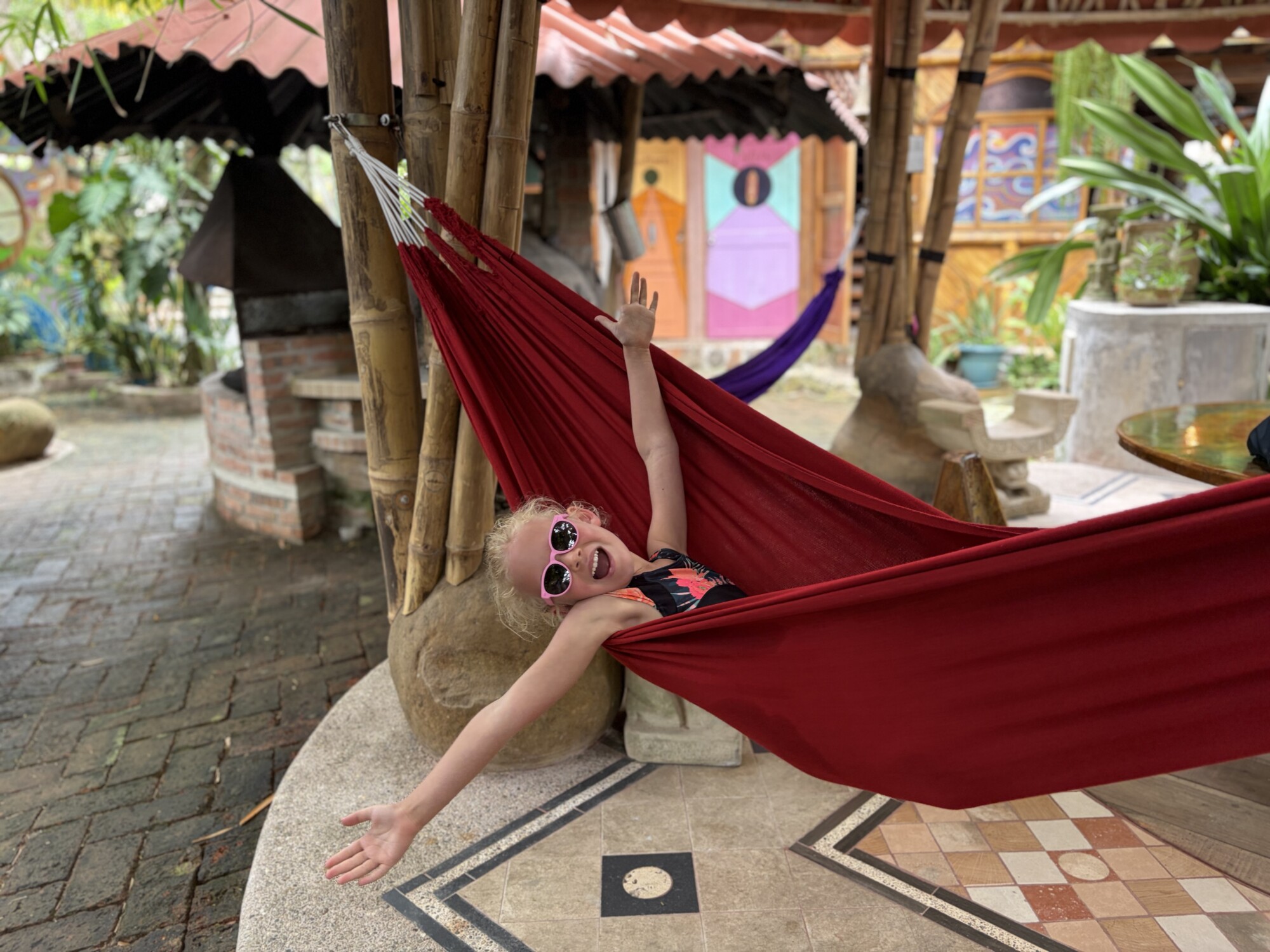
The Galapagos Islands were not originally part of our Ecuador travel plans.
We had about ten days left at the end of our time in Ecuador and weren’t really sure where we wanted to spend them. The Galapagos had always felt like one of those incredible bucket-list destinations, but also one that seemed complicated and expensive to visit with two young kids.
As we traveled through Ecuador, though, we started talking to locals about the islands and realized the Galapagos didn’t have to mean booking a cruise or moving between islands every few days.
So we decided to spend nine nights on Santa Cruz Island and make Puerto Ayora our home base.
If you are wondering, the Galapagos lived up to everything we had built it up to be.
We spent our days swimming, snorkeling, walking to beaches, looking for wildlife, cooking at our Airbnb, and letting our kids spend hours in the water. We didn’t island hop, take expensive day cruises, or try to see everything the Galapagos had to offer.
This guide is everything we learned from visiting Santa Cruz Galapagos with kids, including how to get there, where to stay, what it costs, where to eat, what to expect with young kids, and the things we think are actually worth doing.

How to Get to Santa Cruz Island in the Galapagos
Getting to Santa Cruz is a little more complicated than simply flying into the Galapagos and taking a taxi to your hotel.
We were finishing our trip through mainland Ecuador on the coast near Montañita, so we flew to the Galapagos from Guayaquil. Flights to the Galapagos operate from mainland Ecuador through Quito and Guayaquil, with Baltra being the airport you’ll use if you’re staying on Santa Cruz.
But Baltra Airport isn’t actually on Santa Cruz Island.
It’s located on tiny Baltra Island immediately north of Santa Cruz, while Puerto Ayora is all the way on the southern side of Santa Cruz. That means landing is only the beginning of getting to your accommodation.
The process looks like this:
Baltra Airport → bus → ferry → bus or taxi → Puerto Ayora
After leaving the airport, we took the bus to the Itabaca Channel, which separates Baltra from Santa Cruz. We paid $15 for our family of four for this portion of the trip (our youngest was free).
From there, everyone gets off the bus with their luggage and takes the short ferry across the channel to Santa Cruz Island. We paid $4 total for our family.
Once you reach Santa Cruz, you have two main options for getting the rest of the way to Puerto Ayora: take the bus or hire one of the taxis waiting near the ferry.
We chose the bus on our way into Puerto Ayora and paid $12.50 for our family of four. A taxi was around $30 at the time, so the bus was an easy place for us to save some money.
There is a tradeoff, though.
The bus takes longer and doesn’t take you directly to your accommodation. Once we reached Puerto Ayora, the taxis waiting near the bus had already filled with passengers who got off before us. With no taxis left, we ended up walking about a mile through town with our luggage and two kids to reach our Airbnb.
On the way back to the airport, we did things differently and paid $30 for a taxi.
Neither option is necessarily better. If you’re traveling light and trying to keep costs down, the bus works. If you’re arriving with young kids, several suitcases, or after a long travel day, paying more for the taxi may be completely worth it.
Just know before you arrive that getting from Baltra Airport to Puerto Ayora involves several steps. You’re not going to walk out of baggage claim, get in a car, and arrive at your hotel ten minutes later.
Galapagos Transit Control Card and National Park Entrance Fees
Before you start planning what you’re going to do in the Galapagos, there are two costs you need to know about because you cannot avoid them: the Transit Control Card (TCT) and the Galapagos National Park entrance fee.
Galapagos Transit Control Card
Every person entering the Galapagos as a tourist needs a Transit Control Card.
The TCT is essentially part of the Galapagos immigration control system. It records information about who is entering the islands, where they’re staying, and how long they’re planning to stay. Tourists are currently permitted to stay in the Galapagos for a maximum of 60 days.
The TCT costs $20 per person, so we paid $80 for our family of four.
You can preregister your information online before your trip, which I highly recommend doing before heading to the airport. You’ll enter information about your identity, flights, accommodations, and planned arrival and departure dates. You still need to have the information validated as part of the process before flying to the Galapagos.

Galapagos National Park Entrance Fee
Then comes the expensive one.
Foreign tourists currently pay $200 per adult and $100 per child under 12 to enter the Galapagos National Park. This must be paid in CASH. For our family of two adults and two young kids, that meant paying $600.
This fee is mandatory. There isn’t a cheaper ticket, family pass, or way to plan around it.
We paid ours after arriving in the Galapagos as part of the arrival process before continuing on to Puerto Ayora.
It definitely hurt to hand over $600 before we had even made it to our Airbnb, but the entrance fee goes toward the conservation and protection of the Galapagos. And after experiencing just how special these islands are, I was happy knowing that part of the cost of visiting them goes toward keeping them that way.
Between the $80 TCT and $600 National Park fee, we spent $680 before we really started our time in the Galapagos.
It’s a significant upfront cost, especially for a family, and something you absolutely need to include when budgeting for a Galapagos family trip.
But as we learned once we got to Puerto Ayora, paying a lot to enter the Galapagos doesn’t mean you have to spend a lot every day you’re there.
Where to Stay on Santa Cruz Island With Kids
If you’re visiting Santa Cruz Galapagos with kids, I would stay in Puerto Ayora.
Puerto Ayora is the main town on the southern side of Santa Cruz and puts you within walking distance of restaurants, shops, the waterfront, grocery stores, playgrounds, and several of the beaches and activities you’ll probably want to visit.
We stayed a couple of blocks inland from the main waterfront area, which ended up being a great location for us. We were close enough to walk down to the waterfront whenever we wanted, but we weren’t staying directly in the busiest tourist area.
We could walk to the grocery store, restaurants, the playground along the waterfront, and several of the places we wanted to visit without needing transportation every time we left our Airbnb.
Our Airbnb in Puerto Ayora
We rented a two-bedroom, one-bathroom Airbnb with a full kitchen on the ground floor of an apartment building. We also had access to a shared laundry area, which is always helpful when you’re traveling with kids and spending most of your days swimming.
The kitchen was probably the most important part for us. We stayed for nine nights and cooked the majority of our meals at home, so having an actual place to live instead of treating Puerto Ayora like a short vacation made a big difference.
Why We Stayed on One Island
We had about nine days to spend in the Galapagos, and from the beginning, we knew we didn’t want to spend them constantly moving between islands.
Isabela was definitely tempting, but getting there would have meant working around limited ferry schedules, packing everything up again, moving our kids, checking into another place, and then doing the entire thing in reverse a few days later.
For us, that would have taken away from the reason we wanted to go in the first place.
We wanted to actually experience the Galapagos, not spend our limited time trying to see as much of it as possible. So we made Puerto Ayora our home base and stayed on Santa Cruz for the entire trip.
That gave us a home instead of an itinerary we constantly had to keep up with. We could wake up, eat breakfast, head to the beach, swim and snorkel for a few hours, come home during the hottest part of the day, and head back out later.
And we never felt like staying on one island meant we were getting a lesser version of the Galapagos.
We saw the wildlife we had come to see, spent hours in the water, explored beaches, visited the Charles Darwin Research Station and Las Grietas, and the type of days our kids actually enjoy.
For our family, staying on Santa Cruz didn’t feel like a compromise. It meant fewer moving days, less transportation, and more time actually enjoying where we were.
Where to Eat and Buy Groceries in Puerto Ayora
You definitely won’t have trouble finding restaurants in Puerto Ayora, especially around the waterfront. But this is also the most touristy part of town, and the prices reflect that.
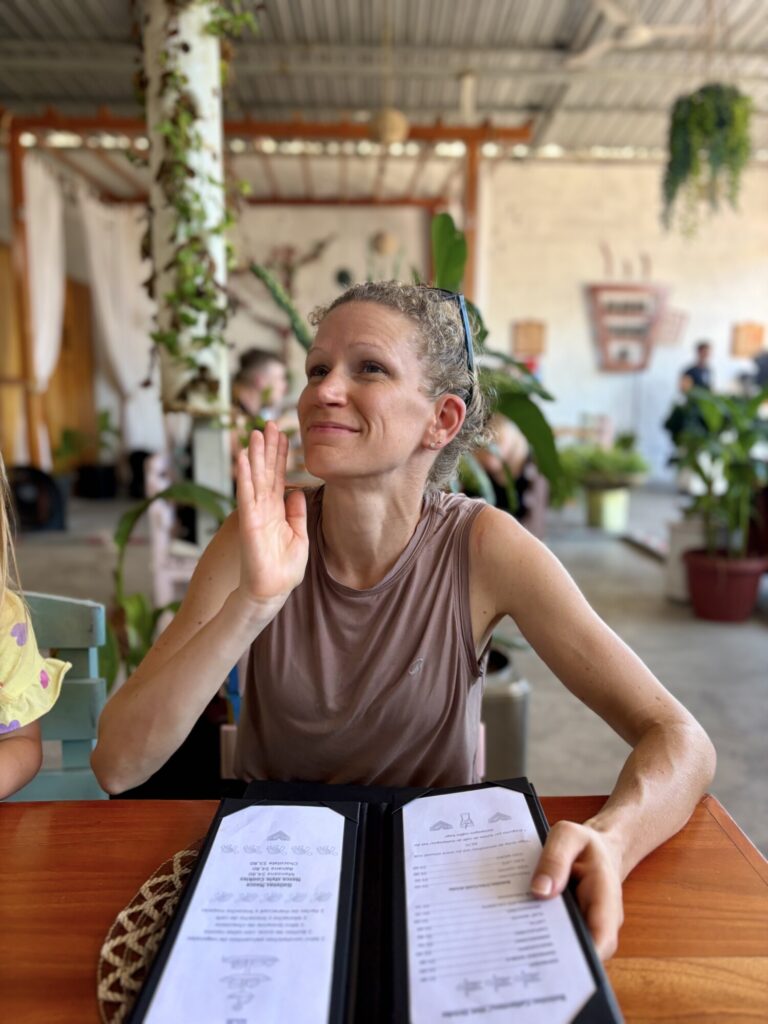
We ate at Nazca, which was a very Western-oriented restaurant with good-quality food and air conditioning. That air conditioning felt especially good when we stopped in during the intense midday Galapagos heat.
There are plenty of other restaurants, cafes, coffee shops, and gelato places along this main area. We grabbed gelato here with the kids as well, but we didn’t eat most of our meals along the waterfront.
If you walk a few blocks inland, you’ll find more local options and generally better prices. One area to look for is Los Kioskos on Calle Charles Binford, where small restaurants line the street and serve more traditional Ecuadorian and Galapagos food, including a lot of fresh seafood.
We also found smaller local ice cream shops farther away from the waterfront where prices were much lower than what we saw in the main tourist area.
Buying Groceries in Puerto Ayora
We did most of our grocery shopping at Proinsular, the main supermarket we used in Puerto Ayora. It had a much larger selection than the little minimarkets scattered throughout town, so this is where we stocked up for most of our meals.
Depending on where you stay, it can be a bit of a walk, which is another reason I would pay attention to location when choosing your accommodation. There are small markets all over Puerto Ayora if you just need a few things, but we found Proinsular much better when we needed to do an actual grocery shop.
Most of our meals were cooked at our Airbnb.
Our normal rhythm was breakfast at home, get outside early, come back around lunchtime when the heat became intense, eat lunch at the Airbnb, and then head back outside later in the afternoon. We’d usually come home again for dinner.
That rhythm worked really well with young kids, but it also meant we weren’t paying tourist-area restaurant prices three times a day.
We still ate out, got coffee, bought ice cream, and enjoyed the food in Puerto Ayora. Having a kitchen just gave us the option to decide when eating out was actually worth it instead of needing a restaurant for every meal.
What to Expect on Santa Cruz Island With Kids
Santa Cruz was very easy to navigate with kids once we figured out the rhythm of our days.
The biggest thing we had to work around was the heat.
We visited in April, which falls during the warmer season in the Galapagos, and the midday sun was intense. The Galapagos sits directly along the equator, and even when the temperature itself doesn’t sound extreme, being outside in that sun for hours with young kids is a lot. The Galapagos National Park even warns that strong sun is possible throughout the year.
We quickly fell into a routine of eating breakfast at our Airbnb and getting outside first thing in the morning. We’d spend the morning at the beach, swimming, snorkeling, or exploring and then head back to our Airbnb around lunchtime.
That gave us a chance to eat, get out of the sun, and let everyone rest before heading back outside later in the afternoon.
I would not plan a Santa Cruz itinerary with young kids that has you sightseeing from morning until evening. Breaking the day into morning and late-afternoon activities worked so much better for us.
Bring More Sun Protection Than You Think You Need
We brought hats, plenty of water, and swimwear that covered as much skin as possible.
For the kids especially, I would bring long-sleeve SPF swimwear or rash guards. You’re going to spend a lot of time around the water, and having their skin covered meant we didn’t have to continually cover their entire bodies in sunscreen throughout the day. If you do put on sunscreen, make sure that you have mineral based sunscreen, to better protect marine life. This can be difficult to find in Ecuador, so think about bringing it with you from home.
You also need more water than you think you do. We carried water anytime we were heading out, especially if we were walking somewhere like Tortuga Bay or planning to spend several hours at the beach.
Puerto Ayora Is Very Walkable
One of the reasons we liked staying in Puerto Ayora was that we didn’t need transportation every time we wanted to do something.
We walked to restaurants, the grocery store, the waterfront, playground, beaches, and several of the activities we did during our stay.
When something is farther away or the kids are done walking, taxis are easy to recognize because they’re generally white pickup trucks. The Galapagos National Park also lists taxis as one of the standard ways to get around Puerto Ayora.
We never felt like we needed to rent a car to make Santa Cruz work.

Wildlife Is Part of Everyday Life Here
This was probably the coolest part of visiting the Galapagos with kids.
You don’t necessarily have to book a wildlife tour to start seeing the animals you came all this way to see.
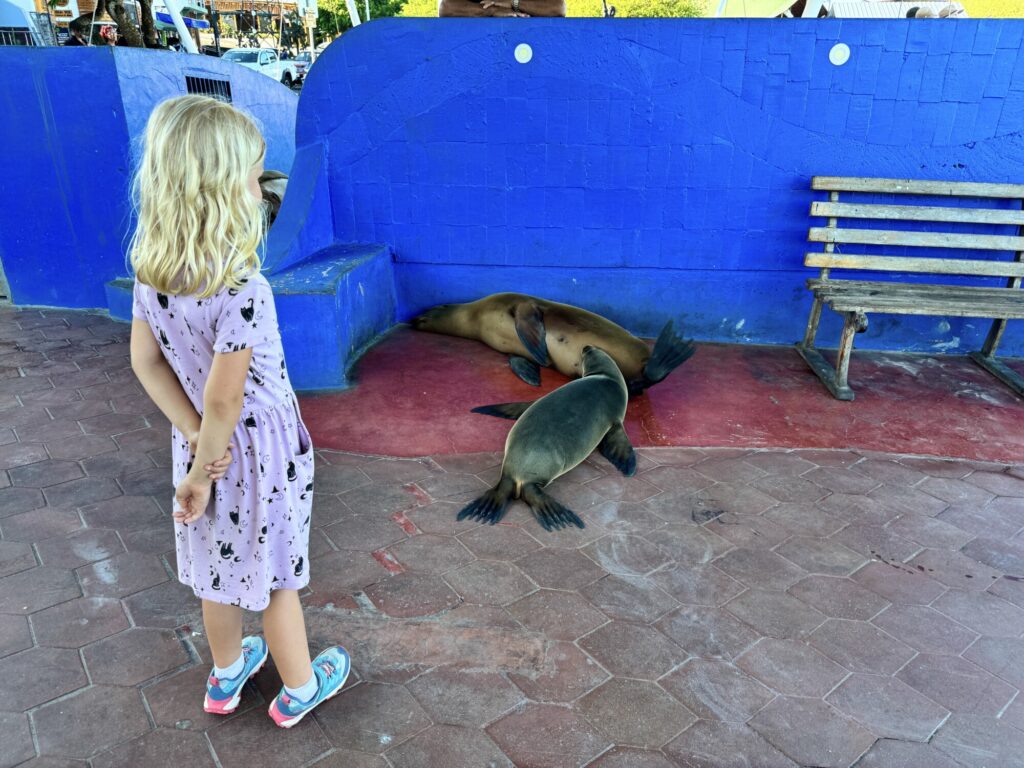
We saw wildlife while walking around town, hanging out near the water, snorkeling, and spending time at the beaches. Instead of every animal encounter being part of a scheduled activity, the wildlife was just part of being there.

That also means kids need to understand that the animals aren’t there to be touched or approached. Galapagos National Park asks visitors to stay at least two meters away from wildlife, never touch or feed animals, stay on designated trails, and leave things like rocks and sand where they are.
For our kids, that became part of the experience too. They could stop and watch an animal for as long as they wanted without needing to interact with it.
You Can Find Plenty to Do Without Booking a Tour Every Day
This was one of our biggest surprises about staying on Santa Cruz.
Before going to the Galapagos, it’s easy to look at all the cruises, boat trips, scuba diving, and organized wildlife tours and assume that’s how you’re going to experience the islands.
That wasn’t the case for us at all.
Staying in Puerto Ayora gave us access to beaches, snorkeling, wildlife, walking trails, the Charles Darwin Research Station, and even a playground right along the waterfront. Several of our favorite experiences on Santa Cruz were completely free.
With two young kids, that freedom was actually better for us than having an activity scheduled every day.
If they wanted to spend two hours swimming, we stayed for two hours. If everyone was hot and tired, we went home. If we wanted to walk down to the waterfront later and get ice cream, we could.
Santa Cruz gave us enough to do that our nine days felt full without ever feeling like we were trying to keep up with the Galapagos.

Things to Do on Santa Cruz Island With Kids
One of our biggest surprises about visiting Santa Cruz Galapagos with kids was how much we could do without booking tours.
We spent most of our nine days swimming, snorkeling, walking to beaches, and looking for wildlife, and some of our favorite experiences were completely free. Staying in Puerto Ayora made this especially easy because several of these places were within walking distance or a quick water taxi ride from town.
1. Charles Darwin Research Station
The Charles Darwin Research Station is on the eastern side of Puerto Ayora and is one of the easiest places to learn more about why the Galapagos is so unique.
There are exhibits about Charles Darwin, evolution, conservation, and the different species of giant tortoises found throughout the Galapagos Islands. Our kids could see different tortoise shells and learn more about how the tortoises evolved differently depending on which island they lived on.
There is also a small movie that plays on a loop, and part of the visitor area is air-conditioned, which we appreciated more than I can explain after walking there in the Galapagos heat.
The main exhibits we visited were free, but there are additional tortoise conservation experiences that may require a separate fee. This is where you can learn more about the work being done to raise and protect giant tortoises before releasing them back into their native habitats.
If you’re walking from the center of Puerto Ayora, just keep the heat in mind. It’s a decent walk with kids, especially in the middle of the day.
You can also easily combine the Research Station with Playa de la Estación since the beach is right along the way.
2. Tortuga Bay
Tortuga Bay was probably our biggest adventure that didn’t require us to book a tour.
Getting there is part of the experience.
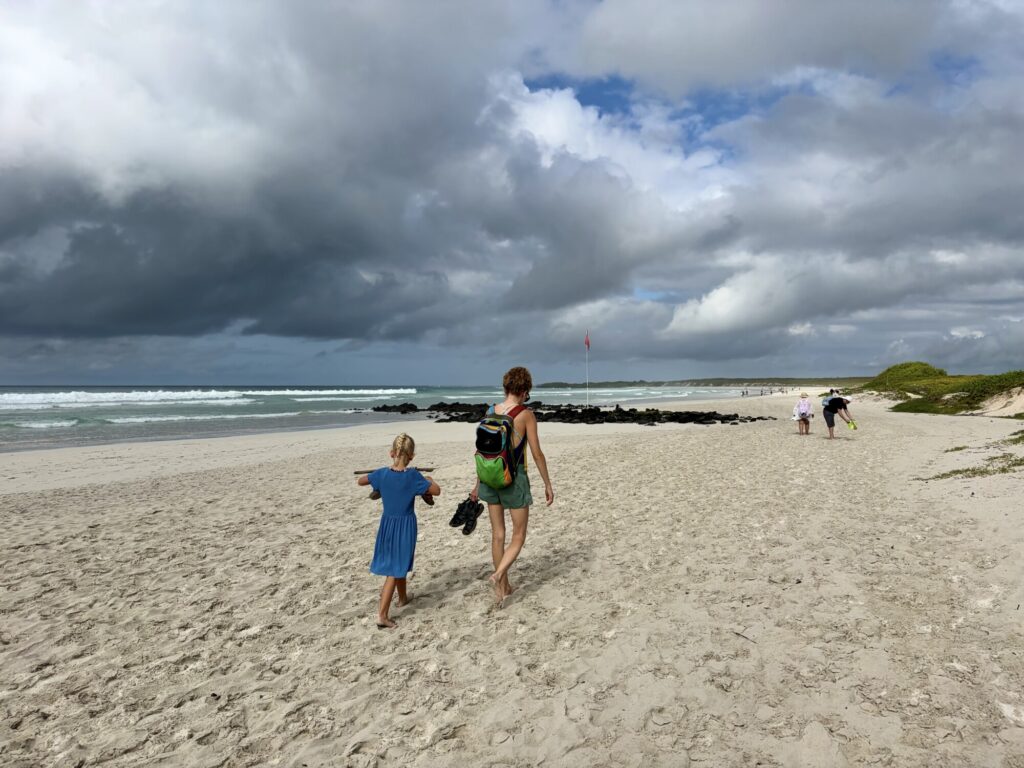
From Puerto Ayora, you follow a long walking trail toward the coast. It took us around 45 minutes with the kids, and much of the trail goes through the vegetation away from town.
This was actually where we saw one of our favorite animals of the entire trip: a giant tortoise just casually walking around.
We also saw tons of birds along the trail, including the famous Darwin’s finches.
Eventually, the trail opens onto a huge white-sand beach called Playa Brava. It is beautiful, but this is not the beach I would choose for swimming with kids. The surf can be very rough, and there were warnings about the conditions when we visited.
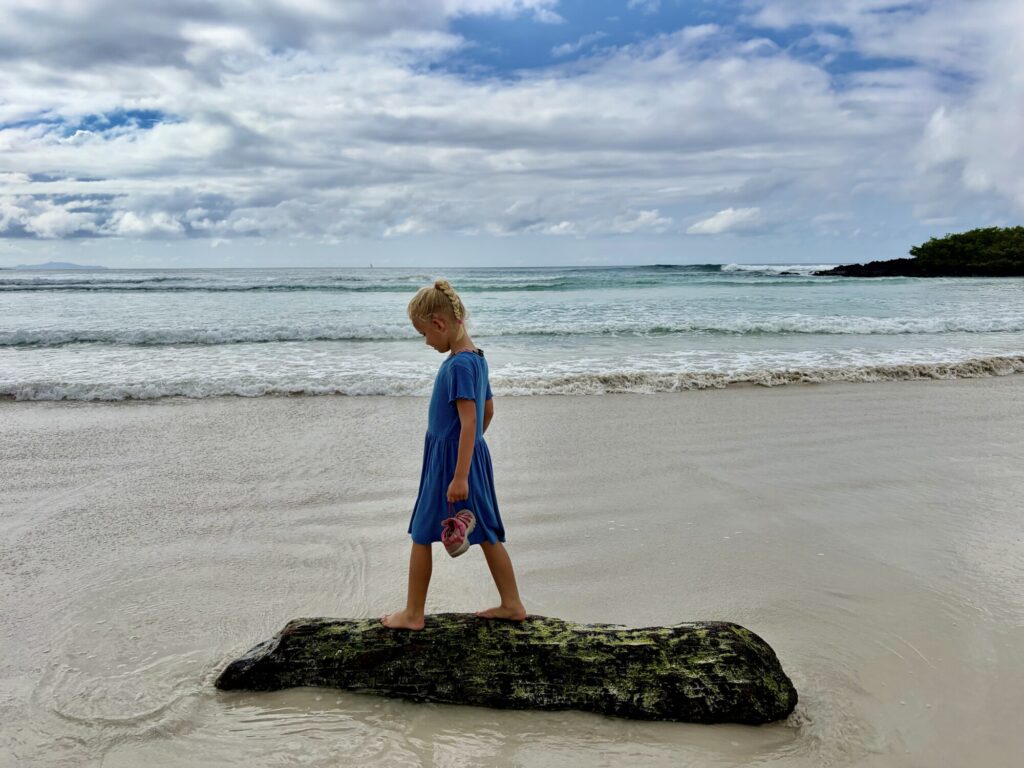
You then have to continue walking along this huge stretch of beach to reach the calmer bay on the other side.
The walk was completely worth it.
Marine iguanas were lounging all over the sand, and once we reached the protected water, we saw baby hammerhead sharks, baby blacktip reef sharks, and tons of fish.
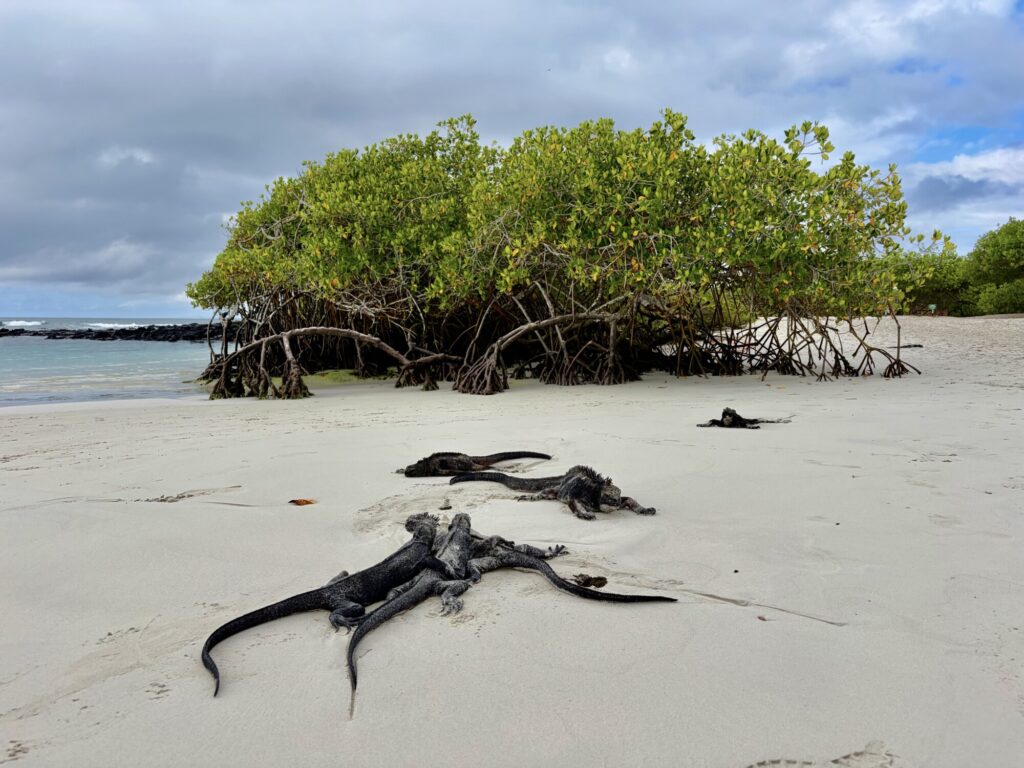
The water wasn’t as clear here as some of the other places where we snorkeled on Santa Cruz, but the entire experience of getting there, seeing the wildlife along the way, and finally reaching the bay made Tortuga Bay one of our favorite days.
Just know that this is a long outing with young kids.
We did not find the trail stroller-friendly, so if you have a child who can’t comfortably walk that distance, I would bring a child carrier. We always travel with one and were very glad we had it.
Bring plenty of water and snacks as well. Once you’re out there, you’re in a protected natural area rather than a developed beach lined with restaurants and shops.

3. Las Grietas
Las Grietas was one of the few activities we actually paid for on Santa Cruz.
To get there, you first take a water taxi from Puerto Ayora across Academy Bay. Once you’re dropped off on the other side, follow the signs toward Las Grietas. The walk took us around 15–20 minutes and passes Playa Los Alemanes along the way.
That makes these two really easy to combine into the same outing.
Las Grietas itself is completely different from the beaches around Santa Cruz. You’re swimming through a narrow, clear water-filled crevice with tall volcanic rock walls rising on both sides.
The water was chilly and clear when we visited, and we could see large fish swimming below us. Definitely bring your snorkel gear.
The biggest thing I would know before bringing young kids is that this isn’t a beach.
You enter the water from a platform, and it gets deep immediately. There isn’t a shallow sandy area where a young child can stand and slowly work their way into the water.
Our youngest wasn’t a strong swimmer yet, so we rented her a life jacket from a small rental stand near the beginning of the walk after getting off the water taxi. If you’re visiting with a non-swimmer or a child who isn’t extremely confident in deep water, I would absolutely plan on a life jacket.
We paid $30 for our family to visit Las Grietas and another $4 to rent her life jacket. This fee includes the mandatory guide that takes you out to the slot canyon and back. You do have about a 40 minute time limit to swim before your group must head back.

4. Playa Los Alemanes
We liked Playa Los Alemanes so much that we went more than once.
You’ll pass it on the walk to Las Grietas after taking the water taxi across from Puerto Ayora, so you can easily visit both on the same day. But I also think this beach is worth coming back to on its own, especially with younger kids.
The bay was calm when we visited, with clear, shallow water and essentially no waves.
Our four-year-old wasn’t a swimmer yet, and this was one of the places where she really started coming into her own in the water.
The first time we visited, she still had the life jacket we’d rented for Las Grietas. The second time, we arrived early enough that the life jacket rental wasn’t open yet, and it didn’t matter. She could hang out in the shallow, calm water and play without being knocked around by waves.
There was also so much to see.
We watched frigatebirds and other seabirds flying overhead, saw sea lions swimming nearby, and found tons of fish once we put on our snorkels. Around the rocks and mangroves, you could just float and watch fish moving through the water.
And Playa Los Alemanes itself is completely free. You just need to pay for the water taxi to get across the bay from Puerto Ayora.
For families with younger kids, this was our favorite beach on Santa Cruz.

5. Playa de la Estación
Playa de la Estación is another really easy beach to add to a day in Puerto Ayora because it’s located near the Charles Darwin Research Station.
As you’re walking toward the Research Station, you’ll take a small turnoff toward the water before reaching the main visitor area.
There is a small beach area as well as a rocky platform where you can get into the water.
The water was clear when we visited, with plenty of fish to see while snorkeling, but what made this area fun for us was once again the wildlife.
Marine iguanas were everywhere.
We could sit near the water and watch them lounging on the rocks while pelicans and other seabirds flew around us. If you slow down and actually look around, there is almost always something happening.
And that’s really what made Santa Cruz so much fun with our kids.
Even walking around the main waterfront in Puerto Ayora, we’d see huge pelicans, marine iguanas, sea lions, and birds hanging around the docks.
We didn’t need every wildlife encounter to be an excursion.
Sometimes we just sat there and watched.
Honorable Mention: Giant Tortoise Reserves in the Santa Cruz Highlands
We didn’t personally visit one of the giant tortoise reserves in the Santa Cruz Highlands, but we met other families who did and really enjoyed the experience.
Several of these reserves are located inland in the higher-elevation part of Santa Cruz, roughly between the Itabaca Channel ferry crossing and Puerto Ayora. Because of that, they can be an easy stop to add on either your arrival day or your departure day instead of making a separate trip back up the island.
A common way to do this is to hire a taxi after crossing onto Santa Cruz, stop at one of the tortoise reserves for a couple of hours, and then continue down to Puerto Ayora. You can also do the same thing in reverse when heading back toward Baltra Airport.
These reserves give you the chance to see giant tortoises roaming in a more natural highlands environment rather than only seeing them through a research or conservation setting.

Final Thoughts on Visiting Santa Cruz Galapagos With Kids
Before we went to the Galapagos, I think we had built it up as this destination that needed to be a huge trip. Multiple islands, expensive tours, boats, scuba diving, and trying to see as much as possible while we were there.
But that wasn’t the experience we ended up having at all.
We spent nine days on Santa Cruz Island, stayed in one Airbnb in Puerto Ayora, cooked most of our meals, walked almost everywhere, and filled our days with beaches, snorkeling, wildlife, and plenty of time in the water.
And we never felt like we missed the Galapagos because we didn’t see every island.
If anything, slowing down gave our kids time to actually enjoy where we were. They could spend hours snorkeling instead of rushing to the next activity. We could stop and watch marine iguanas or sea lions without worrying about a tour schedule. And when the midday heat became too much, we could go home, eat lunch, cool off, and head back outside later.
The Galapagos absolutely lived up to what we hoped it would be.
You don’t have to experience every island or book every excursion to make a trip here worthwhile. For our family, making Santa Cruz our home for nine days gave us everything we wanted from the Galapagos without exhausting ourselves trying to do it all.
Sometimes seeing less gives you a lot more time to actually experience where you are.
More on the Blog:
Cotopaxi With Kids: What Families Should Know Before You Go