
If you’re planning an Ecuador trip with kids and love nature the way we do, Quilotoa probably pops up pretty quickly in your research. It definitely did for us. Between travel blogs and photos floating around Instagram, that turquoise Quilotoa crater lake looked almost unreal.
So as we mapped out our route through Ecuador, it made sense.
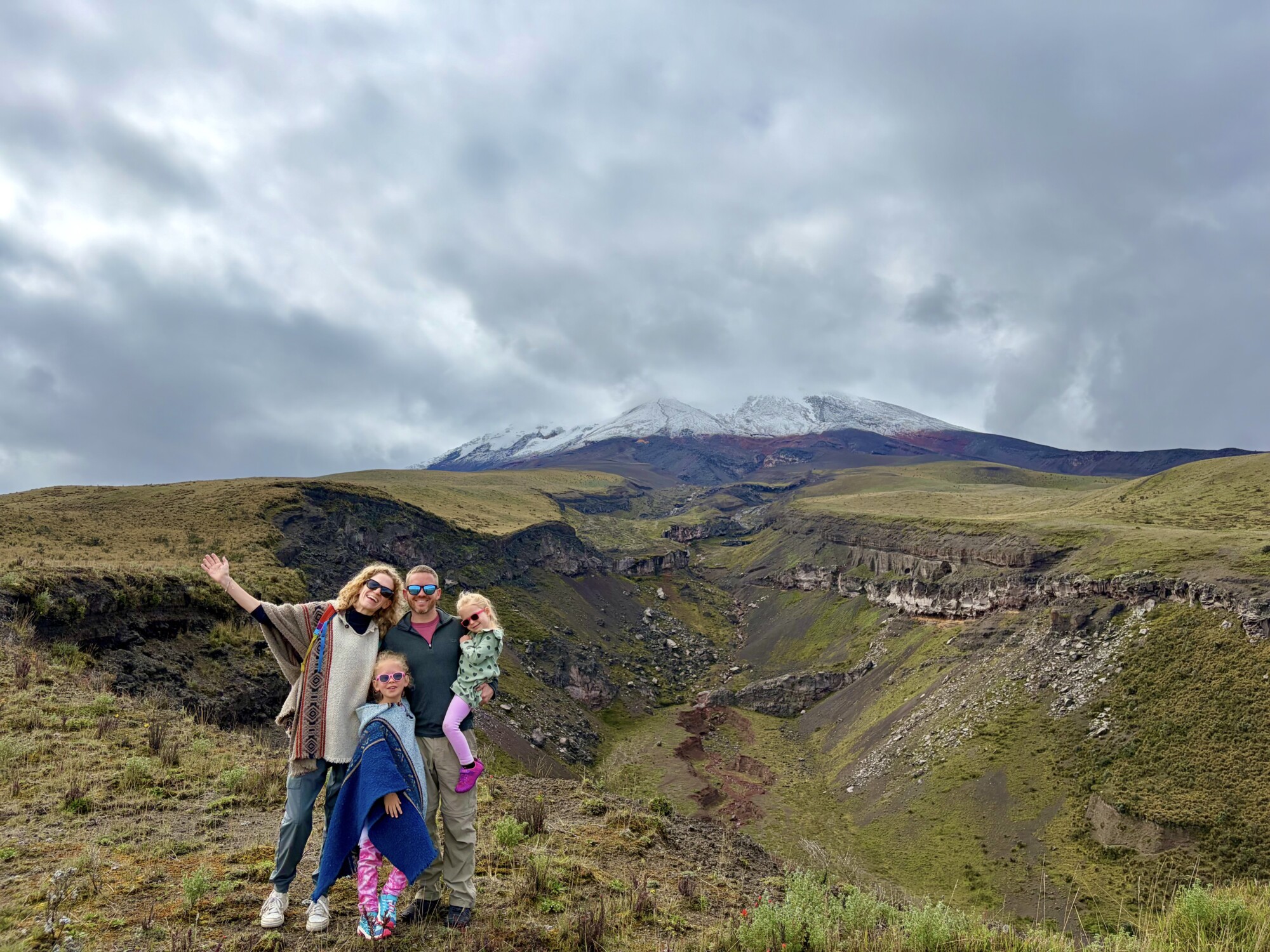
We started in Quito, moved south to Cotopaxi, and from there visiting Quilotoa, Ecuador felt like the next logical step on the journey. It sits further south in the Andes, tucked into a small mountain village built right on the rim of an imploded volcano.
What we didn’t fully realize before arriving?
How much the Quilotoa altitude would change the experience.
At nearly 12,800 feet (3,900 meters) above sea level, even simple movement can feel harder than expected.
Especially when you’re hiking back up with kids.
Still, the moment you stand on the rim and see that deep turquoise lake sitting quietly inside the crater, you understand why so many travelers make the journey here.
And for families who love nature and a little adventure, visiting Quilotoa, Ecuador with kids can end up being one of the most memorable stops in the country.
Getting to Quilotoa From Cotopaxi
Let’s start with logistics, because getting to Quilotoa can sound a little confusing when you first start researching it.
We were staying just outside Cotopaxi National Park, and the closest larger town nearby is Machachi. From there, we decided the easiest option for our family was simply booking an Uber directly to Quilotoa village.
The ride took about two and a half hours and cost $41.23.
Before we left, we confirmed with the driver that he was comfortable making the trip up into the mountains, and he said it was completely fine. The route is fairly common, and drivers are used to taking people between towns in this region.
The drive itself was beautiful.
You wind through the Andes for most of the trip, passing small villages, open farmland, and long stretches of mountain scenery.
That said, it’s definitely a winding mountain road.
Our youngest gets motion sickness, so she struggled a little with the curves along the way. If your kids deal with that too, it might be worth planning ahead with snacks or breaks.
Taking the Bus Instead
If you’re trying to keep costs lower, buses are another very realistic option.
The typical route is:
- Bus from Machachi to Latacunga
- Then another bus from Latacunga to Quilotoa
These routes run frequently, usually every 30 minutes or so, and they’re used constantly by locals and travelers alike. Later in our trip we took buses throughout Ecuador and realized how easy the system actually is.
So while we chose Uber for the simplicity of going straight from point A to point B with the kids, taking the bus would likely be much cheaper and still fairly straightforward.
For families planning visiting Quilotoa, Ecuador with kids, either option can work depending on your travel style.

First Impressions of Quilotoa Village
We arrived in Quilotoa later in the evening after the drive from Cotopaxi, and the first thing we noticed was how quiet everything felt.
Quilotoa village is very small. Everything sits clustered together right along the rim of the crater, and you can walk across most of the town in just a few minutes. It feels more like a small mountain outpost than a typical tourist town.
But what really stood out was how early things shut down.
By the time we arrived, most of the town had already closed. Shops were dark, streets were mostly empty, and it felt like the entire place had gone to sleep. From what we experienced, many restaurants and small shops close around 5 PM, which can catch you off guard if you’re arriving later in the day like we did.

We eventually found one restaurant still open, Kirutwa, and it ended up being the same place we returned to the next night simply because the kids actually liked the food. When you’re traveling with kids, finding a place everyone will eat without a fight is sometimes reason enough to go back. When in the Andes, you must try Canelazo, the drink shown in the picture above. You can get it with or without alcohol!
The overall feeling of the town is calm and quiet. There isn’t much nightlife, no busy tourist strip, and not a long list of things to do in Quilotoa once the sun goes down.
And honestly, that’s part of the charm. It feels remote, simple, and peacefu. The real reason everyone comes here isn’t the town itself.
It’s the massive crater sitting just steps away.
The Altitude at Quilotoa (And Why It Matters)
Before talking about the hike itself, we need to talk about the one thing that really shapes the entire experience here: altitude.
The rim of Quilotoa sits at about 12,800 feet (3,900 meters) above sea level. That’s significantly higher than many places people visit in Ecuador, and even if you’ve already spent time at elevation, you’ll likely still feel it.
We had already spent a few days near Cotopaxi before arriving, so we weren’t coming straight from sea level. Even so, the Quilotoa altitude was noticeable almost immediately.
Walking uphill made you breathe harder.
Even small inclines felt more tiring than they normally would.
And sleeping the first night wasn’t perfect either, which is pretty common at this elevation.
For families visiting Quilotoa, Ecuador with kids, the biggest thing to remember is that the altitude makes everything feel slower and more physically demanding than it looks on paper.
The Quilotoa hike itself isn’t dangerous or complicated. The trail is wide, well marked, and easy to follow. But the elevation means you’ll want to pace yourself and plan ahead.
A few simple things really help:
- Drink a lot of water
- Eat a good, high-energy meal before hiking
- Take breaks when you need them
- Don’t rush the climb back up
The altitude doesn’t make Quilotoa impossible with kids.
It just means you need to approach it with the right expectations.

Hiking Down to the Quilotoa Crater Lake
The main Quilotoa hike starts right from the edge of the village.
You walk only a few minutes from the center of town before suddenly reaching the rim of the crater. And when you first look down, it’s pretty striking. The entire volcano has collapsed inward, leaving this massive bowl in the earth with the bright turquoise Quilotoa crater lake sitting quietly at the bottom.
The trail zigzags down the side of the crater toward the water.
One thing that surprised us was how manageable the trail itself felt. It’s wide, clearly marked, and very easy to follow. You’re not navigating anything complicated, it’s essentially one main path the entire way down.
There were a few sections where the trail was a little muddy and a few spots with loose rock, but overall it felt safe. The biggest factor wasn’t the terrain, it was simply the altitude.
With our kids (ages six and three), the descent took us about one hour.
Our six-year-old walked the entire way down on her own, and she handled it really well. Our three-year-old rode in a hiking backpack carrier most of the way, which made the descent much easier for us.
There are also small snack huts along the trail where you can buy drinks or snacks if you didn’t bring your own, but we usually prefer to carry water and snacks with us whenever we hike with the kids.
Overall, going down felt pretty relaxed.
You’re constantly looking out over the crater as you descend, and the lake slowly gets bigger and brighter as you make your way toward the bottom.

Reaching the Bottom of the Crater
Once you finally reach the bottom of the trail, the whole experience changes a little.
From the rim, the Quilotoa crater lake already looks impressive. But standing next to it feels completely different. The color is even more vibrant up close, a deep turquoise blue that almost looks unreal against the dark volcanic walls surrounding it.
What surprised us most was how peaceful it felt down there.
The water was completely still. There was almost no wind. And because we went during a quieter time of year, there were very few other people around. Most of the noise from the rim disappears once you’re inside the crater, and it becomes incredibly quiet.
Our kids immediately gravitated toward the water. They love being around lakes and rivers, so this was easily their favorite part of the entire Quilotoa hike.

They spent time walking along the shoreline and exploring some of the small hills and paths around the lake area. There’s a little bit of open space down there where kids can move around and explore without feeling rushed.
One important thing to know: you cannot swim in the lake. The water is protected, and swimming isn’t allowed. However, there are sometimes kayaks available if you want to spend some time out on the water.
Even without that, it was one of the most relaxing moments of the hike for us. After the descent, sitting near the lake and letting the kids explore for a bit felt like the perfect break before tackling the climb back up.
The Hardest Part: Hiking Back Up
If the hike down feels manageable, the hike back up is where the real challenge begins.
Most people take between an hour and a half and two hours to make the climb back up. The trail itself is the same wide, clearly marked path you came down on, but going uphill at nearly 13,000 feet makes every step feel heavier than you expect.
For us, this was also one of the proudest moments of the trip.
Our six-year-old hiked the entire way back up on her own. Once she got into a rhythm, she kept going step by step and actually finished the climb in about one hour and twenty minutes, which is faster than the average time most people take.
We were incredibly proud of her.
Our three-year-old stayed in the backpack carrier the whole time, which made the climb a lot more manageable for us.
This is also where the mule option becomes appealing for some families. Along the trail, you’ll see mule guides offering rides for people who don’t want to hike the entire way up.
A few things to know if you’re considering that option:
- The cost is usually about $10 per mule
- Guides typically operate two mules at a time
- Because of that, they often require you to pay for two mules rather than just one
Even if you don’t plan on using them, it’s helpful to know the option exists.
The key with this part of the hike is simply taking it slow. Between the altitude, the sun, and the steady climb, it’s definitely the most physically demanding part of the Quilotoa hike. But once you reach the rim again and look back down into the crater, it feels pretty rewarding.
Bathrooms, Snacks, and Trail Logistics
At the bottom of the crater, there are bathrooms available, which is helpful if you’re spending time near the lake before starting the climb back up.
Along the trail itself, you’ll pass a couple of small snack huts where you can buy drinks or simple snacks if needed. These aren’t full restaurants, just small stands where locals sell bottled drinks and basic food.
That said, we almost always prefer bringing our own supplies when hiking with kids.
We’d recommend bringing:
- Plenty of water
- Snacks for the kids
- Sunscreen
- A hat
- Good hiking shoes

Final Thoughts
So the real question is: should you plan on visiting Quilotoa, Ecuador with kids?
For us, the answer is yes, but it helps to know what kind of experience you’re signing up for.
Quilotoa isn’t the kind of destination where you show up and casually stroll around for an hour. The main attraction is the Quilotoa hike, and that means hiking down into the crater and climbing all the way back out again at nearly 13,000 feet above sea level.
That’s a real physical effort, especially with kids.
But it’s also one of those places that feels completely different from anywhere else you visit in Ecuador.
Standing on the rim and looking down at the turquoise Quilotoa crater lake is dramatic in a way that’s hard to explain until you see it yourself. Hiking down into the crater makes the experience feel even more immersive, and once you reach the bottom, the quiet and stillness of the lake make it feel almost peaceful.
Our kids loved exploring near the water and walking around the small hills at the base of the crater. And watching our six-year-old push herself to hike all the way back up was one of those proud parent travel moments that sticks with you.
If we were doing it again, the biggest change we’d make would be starting earlier in the morning. Beginning the hike closer to 8 AM would avoid the stronger sun and make the climb back up a little more comfortable.
We’d also still recommend staying overnight in Quilotoa village, even though it’s quiet and everything closes early. Having a relaxed evening and not rushing the hike makes the whole experience feel much more manageable with kids.
Quilotoa isn’t flashy. It isn’t packed with activities. The village is small and sleepy.
But that’s also what makes it special.
And for families who love nature and adventure, visiting Quilotoa is one of those travel memories that tends to stick around long after the trip ends.
More on the Blog:
Why you should go to Cotopaxi National Park